How a Whitening Laser Works Gangnam, Seoul
How does a whitening laser work? A wavelength melanin absorbs far more than the skin around it lands as a picosecond shock, splitting pigment into fragments your own cells flush over the following weeks. RE:BERRY Gangnam reads your pigment first, then paces the passes to that clearance rhythm, two minutes from Gangnam Station.
Skin Whitening Laser
Whitening Laser
How a Whitening Laser Works
How does a whitening laser work? A wavelength melanin absorbs far more than the skin around it lands as a picosecond shock, splitting pigment into fragments your own cells flush over the following weeks. RE:BERRY Gangnam reads your pigment first, then paces the passes to that clearance rhythm, two minutes from Gangnam Station.
Across RE:BERRY Clinics
1,000,000+ Treatments
Direct Consult & Treatment
Medical Director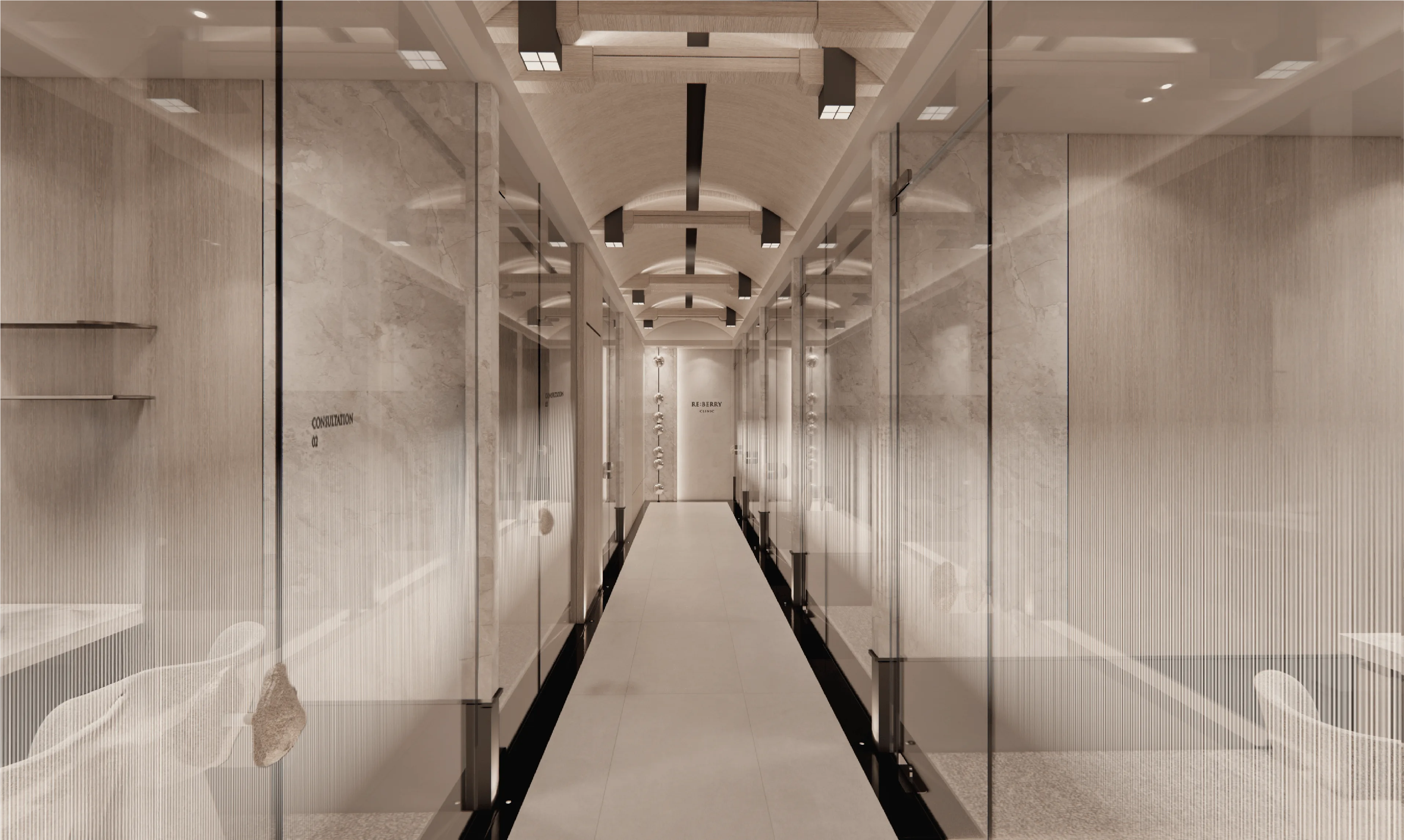
From Gangnam Station Exit 10
2-Min WalkHow does a skin whitening laser actually work?
A whitening laser fires a wavelength that melanin absorbs far more strongly than the surrounding skin, so the pulse passes through the surface, is soaked up by the surplus pigment, and fractures it into sub-micron particles, while the neighbouring tissue stays cool enough to avoid a wound. From there your own dermal macrophages carry the debris out of the skin over roughly two to four weeks. That clearance step, more than the machine itself, brightens the tone between visits and sets the treatment up as a course. It moves the surplus melanin sitting over your baseline; it leaves your inherited tone alone, and it manages melasma without erasing it.
Effects & Progress
Effects & Progress
A whitening laser answers one question first: how do you remove pigment without a wound. The answer is selective absorption. A wavelength melanin takes up far more than the tissue around it, so the pigment breaks while its neighbours stay cool.
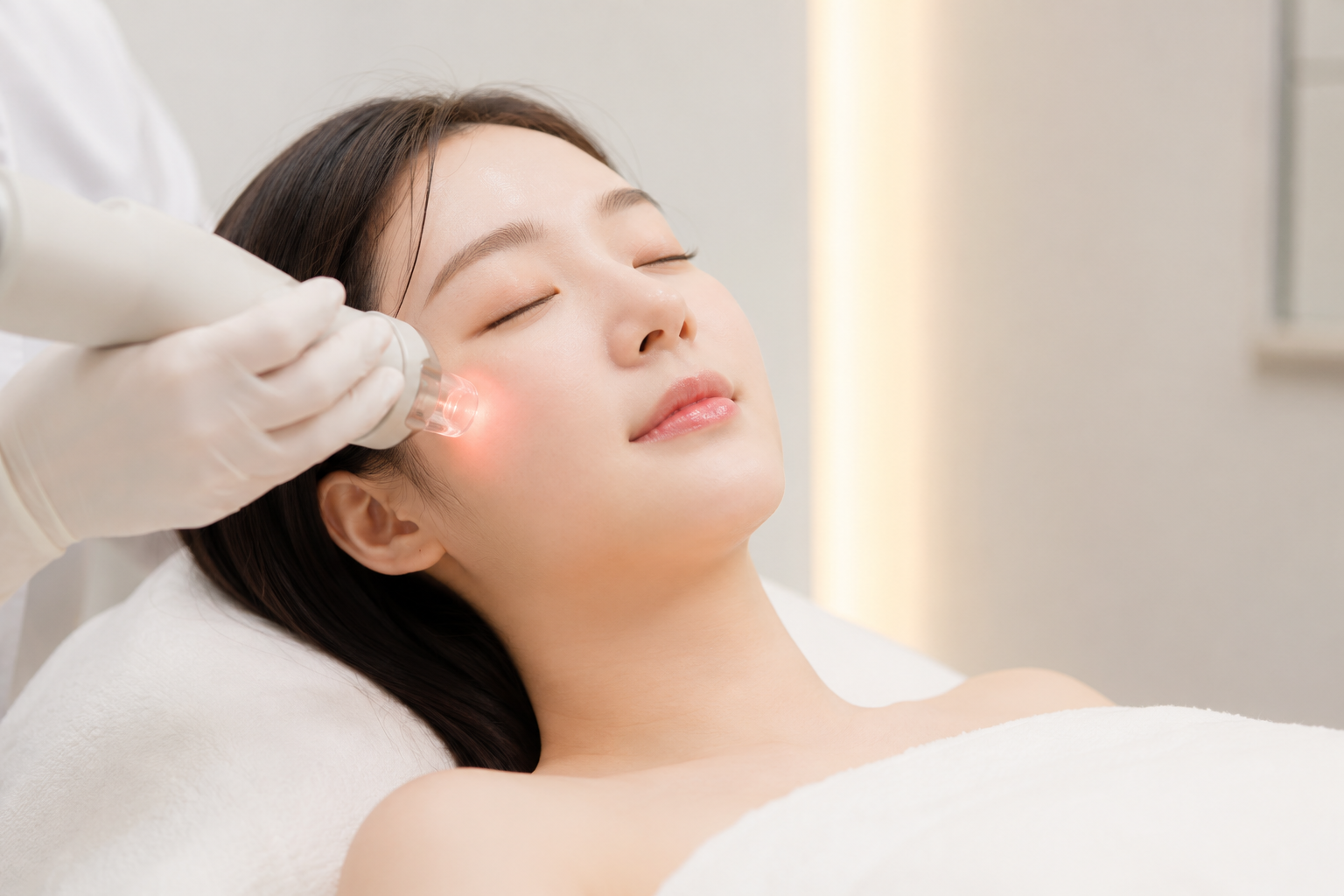
A faint pinkness or warmth may appear straight after the pass and usually settles within two to four hours, with no crust to hide. Some shallow spots briefly darken before flaking, and daily life resumes the same day.
Surface dullness lifts first as the freshest epidermal layer turns over, so the complexion already reads a shade clearer before deeper pigment has moved. The next visit is set three to four weeks out, on the clearance rhythm.
The working phase across the course. As macrophages finish carrying off each pass's debris, diffuse pigment and stubborn marks lighten in thin layers and the tone evens zone by zone. Response speed varies by individual and pigment depth.
Maintenance period. Daily sun protection plus an occasional upkeep visit hold the tone, and for melasma-prone skin RE:BERRY sets a gentle ongoing rhythm with no finish line.
Treatment Process
How a Whitening Laser Works — the Mechanism in 4 Steps
※ Illustrative images are AI-generated to help explain the treatment process.Effects & Progress
Effects & Progress
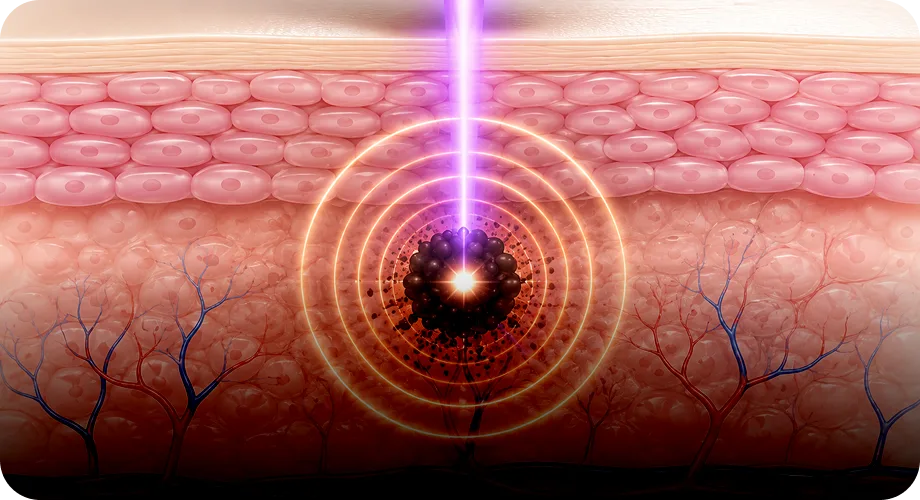
The mechanism behind a whitening laser rests on selective photothermolysis, a principle worked out in the early 1980s: pick a wavelength a target absorbs far more strongly than everything around it, hold the pulse shorter than the time that target needs to shed its energy, and only the target takes the hit. Melanin is the target here. It absorbs 755nm and 1064nm light many times more readily than the surrounding water-rich skin, so the pulse travels through the surface, is soaked up by the pigment, and fractures it into particles fine enough to clear, all while the skin in front of it stays cool enough to avoid a burn. That is how surplus melanin is broken at its source without opening a wound or sanding anything away.

Here is the part most people miss when they ask why one session is not enough. Breaking the pigment is fast; removing it is not. The laser splits surplus melanin into sub-micron fragments, and from there your own dermal macrophages ferry the debris out of the skin over roughly fourteen to twenty-eight days. Each low-fluence pass can only clear the melanin it can safely reach without provoking the surrounding skin, so the tone evens in thin layers across a run of visits spaced three to four weeks apart. Push harder to skip visits and reactive skin rebounds darker, defeating the point. The change is real brightening of your own baseline, and response speed varies by individual and pigment depth.
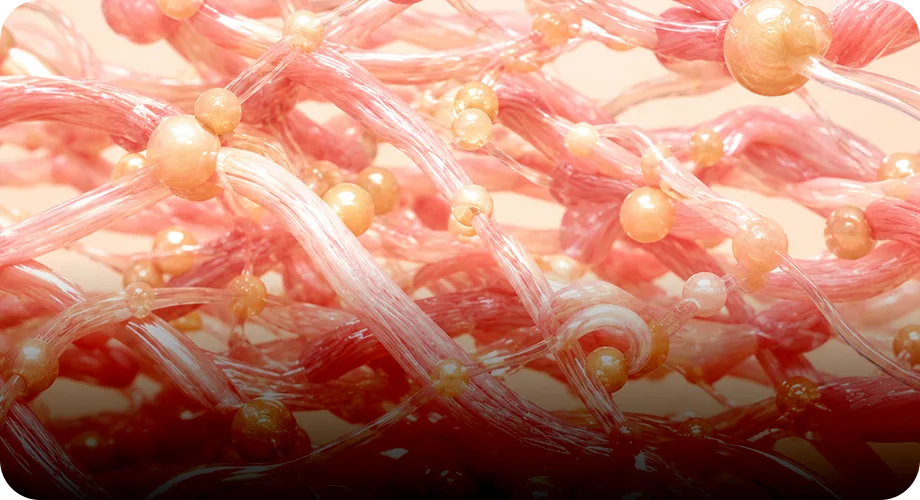
A whitening laser is aimed at pigment, but the mild thermal stimulation carried by the toning wavelength does not go to waste on the way in. Over a course it gives the dermis a low-grade nudge toward collagen, so treated skin tends to read a touch smoother, pores a shade tighter, and the finish carries a healthier glow beside the more even tone. This is a side effect in the useful sense. It arrives with the wavelength you were already using for pigment, and RE:BERRY never itemizes it as a separate service. Pigment control stays the point of the session.

The reason a whitening pass fits a work or travel day is mechanical: the energy passes through intact skin to reach the melanin, so nothing is cut, sanded, or left to scab. The faint pinkness or warmth typically settles within two to four hours, there is no crust or dressing, and makeup goes on shortly after. What it will not do is beat the clock. A whitening laser is honest about its limits. It moves surplus pigment on your macrophages' timeline, it manages melasma as an ongoing plan, and it leaves your inherited tone alone. Set against those limits, the trade is a light, repeatable session that slots into a lunch window or a short Seoul itinerary.
Treatment Process
How a Whitening Laser Works — the Mechanism in 4 Steps
※ Illustrative images are AI-generated to help explain the treatment process.
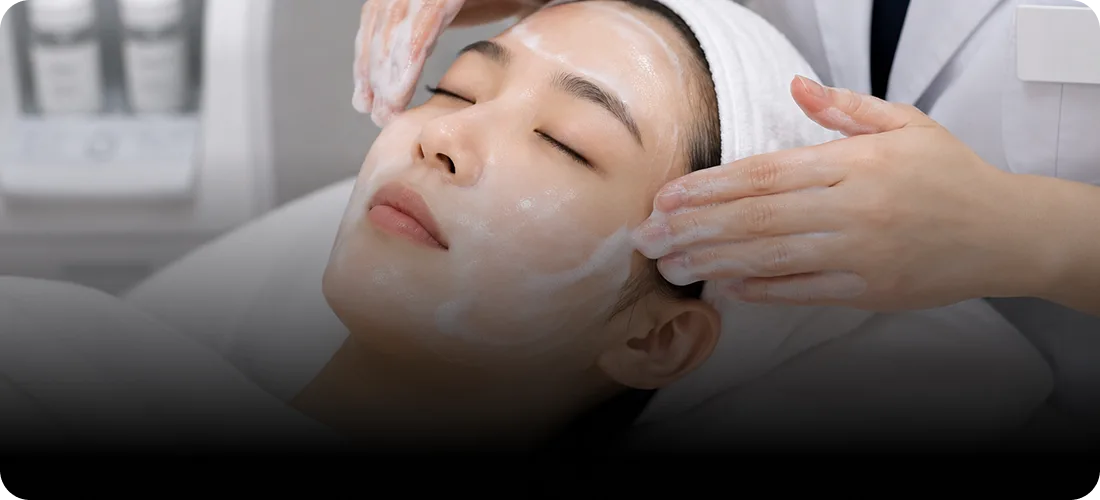
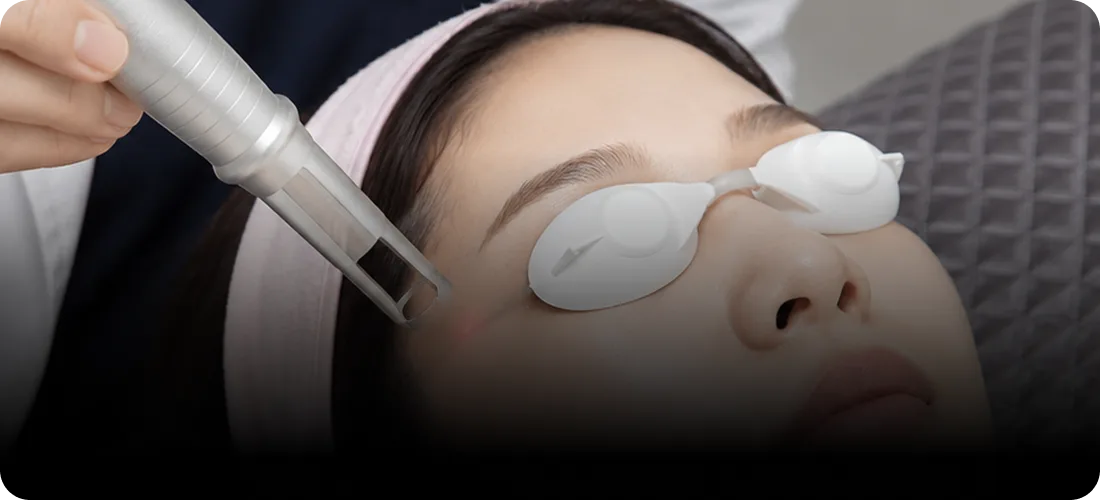
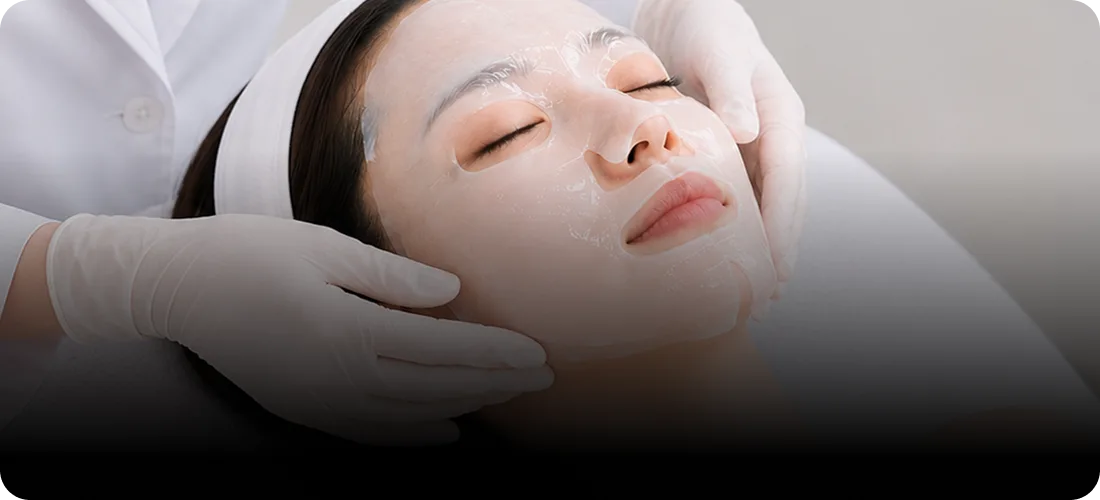
What the Mechanism Means for You — and How the Result Unfolds
- It works by selective absorption: a wavelength melanin takes up far more than the surrounding skin breaks the surplus pigment at its source, so nothing is bleached chemically and nothing is sanded away
- It spares the surface: because the pulse passes through intact skin to reach the melanin, there is no wound, no crust, and the faint pinkness settles in two to four hours
- It is paced to biology: the laser fractures pigment in minutes, but your macrophages need roughly two to four weeks to clear the debris, which is the real reason a course beats a single aggressive pass
- It is depth-tuned: a 755nm picosecond beam handles shallow spots while a 1064nm pulse reaches deeper dermal pigment, so the physician matches the light to your reading, one setting per zone
- It has clear limits: a whitening laser moves surplus melanin, manages melasma with an ongoing plan, and leaves your inherited tone untouched
- It brings a quiet bonus: the mild thermal stimulation that rides along with the toning wavelength nudges dermal collagen, so treated skin often reads a shade smoother beside the more even tone, at no extra charge
| Timeline | What to Expect |
|---|---|
| A working pass takes 20 to 40 minutes; faint pinkness clears in two to four hours with no crust, so makeup and same-day plans are fine, and some shallow spots may briefly darken before they flake | |
| The clearance window: dermal macrophages carry off the fractured pigment, surface dullness lifts first, and the complexion already reads a shade clearer before deeper melanin has moved | |
| Visible brightening builds and the next low-fluence pass is set on this rhythm; diffuse pigment and stubborn marks lighten in thin layers over the weeks that follow | |
| Across the course the tone evens zone by zone; melasma-prone skin moves onto a gentle maintenance rhythm with strict sun protection, an open-ended plan with no finish line |
How Whitening Laser Compares with IPL and a Whitening Drip — by Mechanism
| Criteria | Whitening Laser (RE:BERRY Gangnam) | IPL / Broadband Light | Glutathione / Vitamin Drip |
|---|---|---|---|
| What it targets | A single wavelength tuned to melanin, matched to pigment depth | A broad band of light absorbed by several targets at once | Systemic antioxidant support only, with no pigment target |
| How the pigment is affected | Photoacoustic fracture into sub-micron particles the body clears | Thermal absorption that heats and lifts surface pigment | No direct action on existing melanin deposits |
| Depth reached | Surface with 755nm, deeper dermal pigment with 1064nm | Mainly superficial pigment and vascular tone | Not depth-based |
| Melasma suitability | Low-fluence toning, managed carefully to avoid rebound | Often too hot for melasma; can provoke rebound | Adjunct support only, never the primary answer |
| Downtime | None to speak of; pinkness clears in 2-4 hours | Mild redness, possible micro-crusting on spots | None; delivered by infusion |
| Why a course | Clearance is biological: macrophages need 2-4 weeks per pass | Multiple sessions also typical | Ongoing infusions with limited tone evidence |
| Published price | ₩100,000 (about $71) | Published on its own treatment page | Published on the IV therapy page |
Why This Matters
These three are not interchangeable, and the difference is mechanism. A whitening laser hands one melanin-tuned wavelength a photoacoustic job: fracture the surplus pigment, then let clearance finish it. IPL floods a broad band of light that several targets absorb at once, which lifts surface tone but is harder to keep gentle on melasma. A glutathione drip is systemic support with limited evidence for changing tone, so RE:BERRY Gangnam plans it as an adjunct at most, never as the pigment answer itself.
The question guests ask most is why one session cannot do it all, and the reply comes down to biology. A pass fractures the pigment in minutes, but the fragments leave on your dermal macrophages' schedule across two to four weeks. Each low-fluence pass clears only the melanin it can safely reach, so tone evens in thin layers over a run of visits three to four weeks apart — pushing harder to skip visits is exactly what provokes reactive skin to rebound darker.
KHIDI's 2025 international patient survey found 41.4% of respondents rank keeping the same doctor throughout as their leading criterion. At RE:BERRY the physician who reads your pigment sets the wavelength, delivers every pass, and tracks the fade, so the whitening plan that started with a realistic target is the same plan that finishes it.
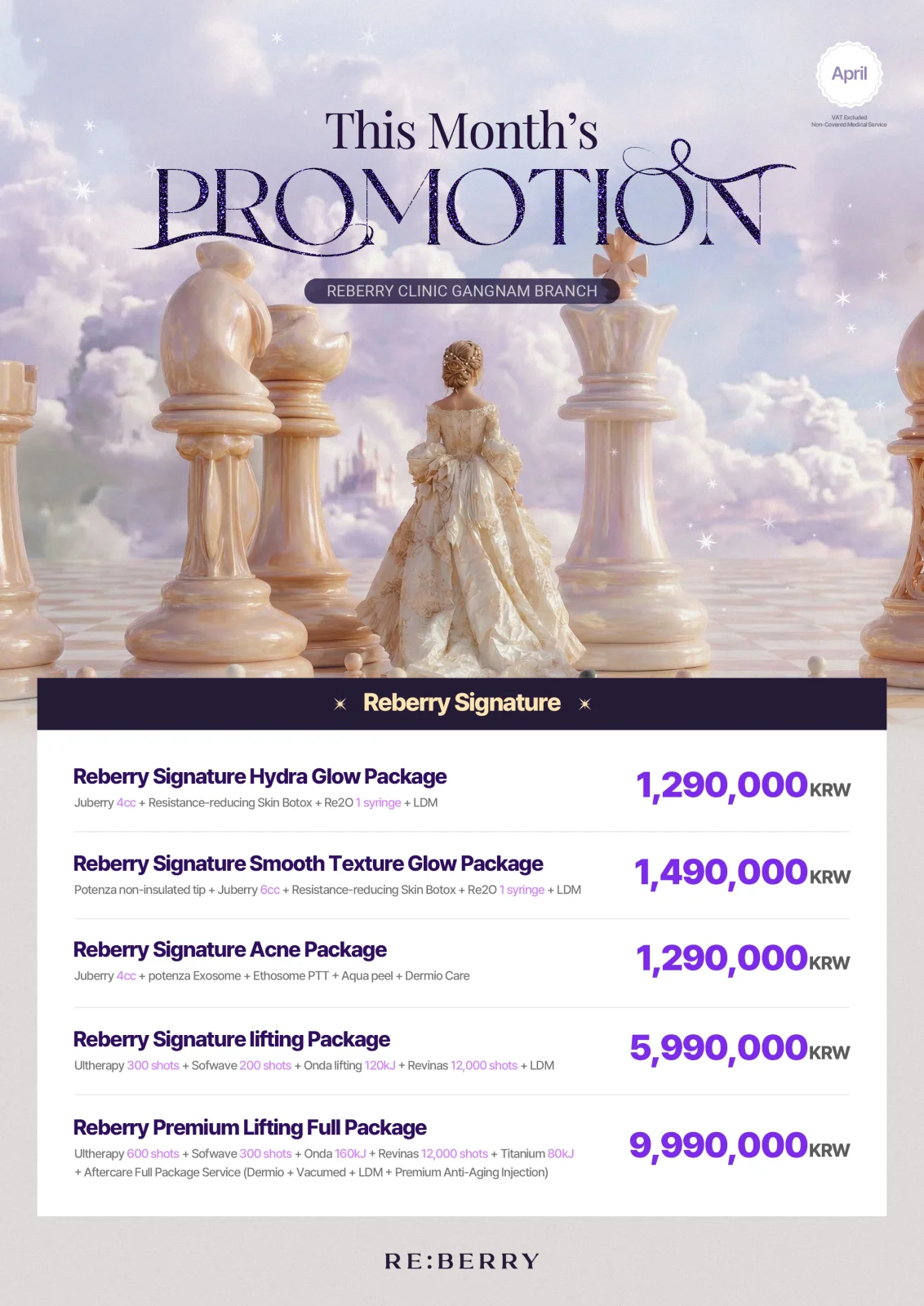
October – December 2026 Promotions
Exclusive packages for international patients. Swipe to see all offers.
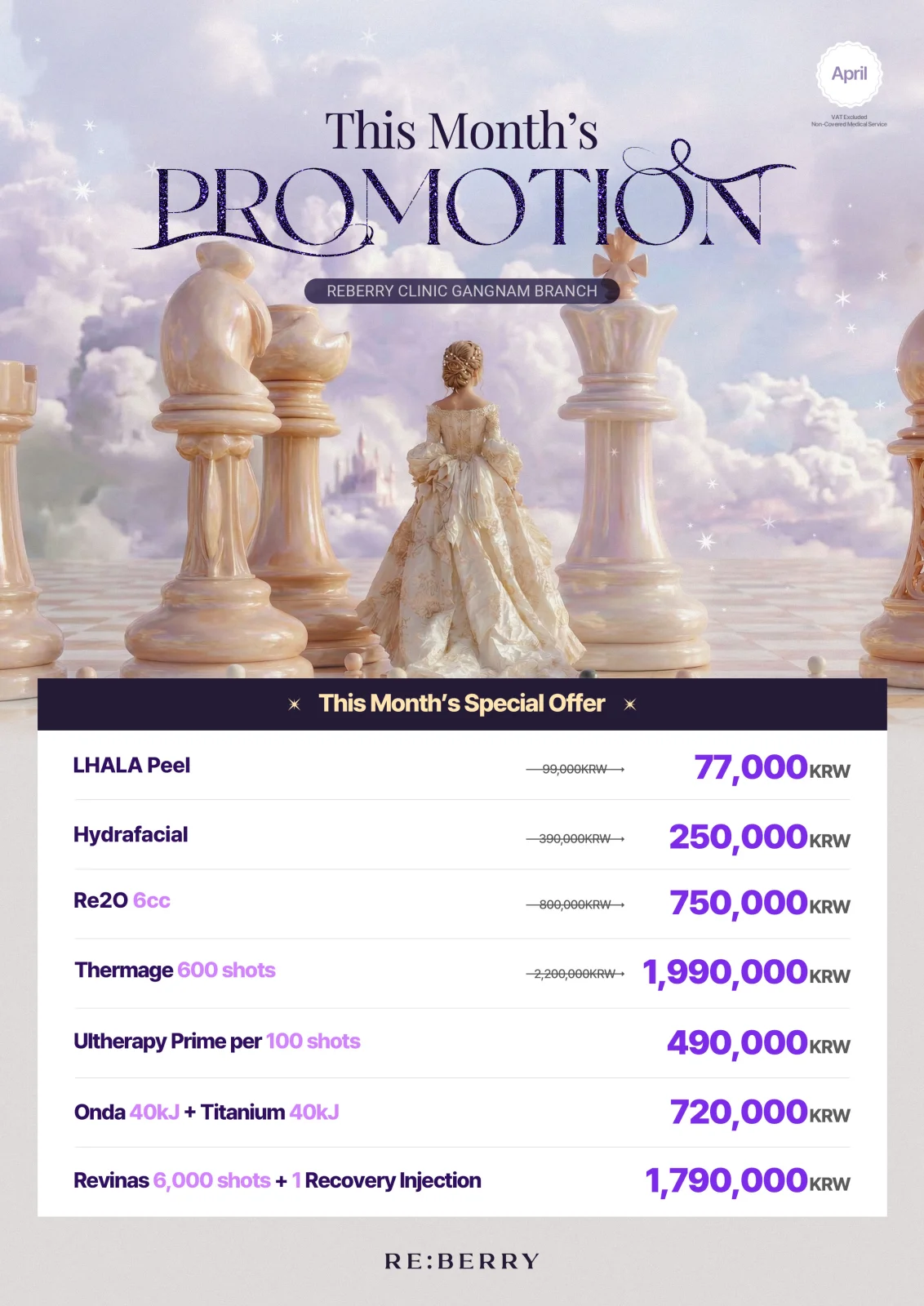
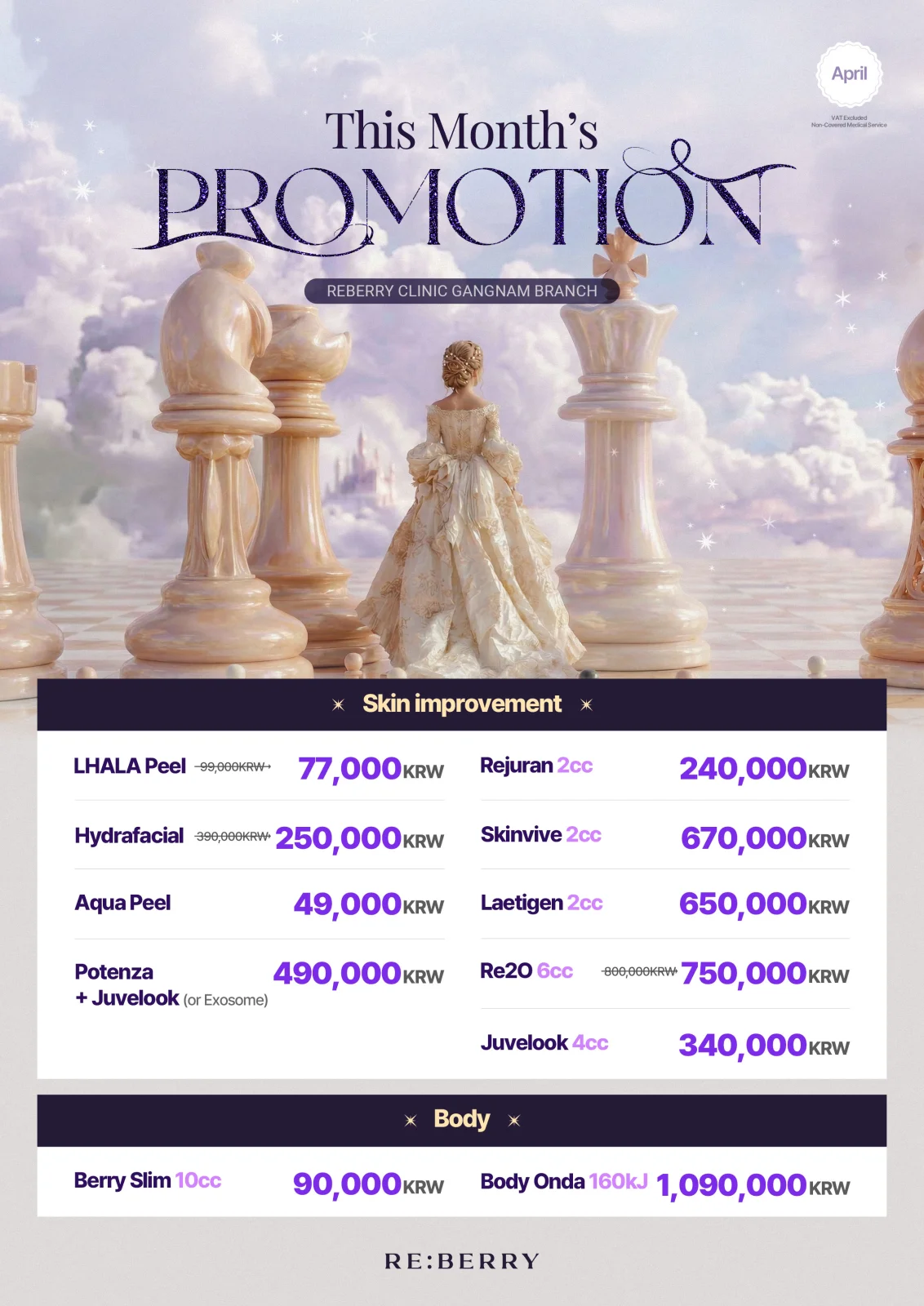
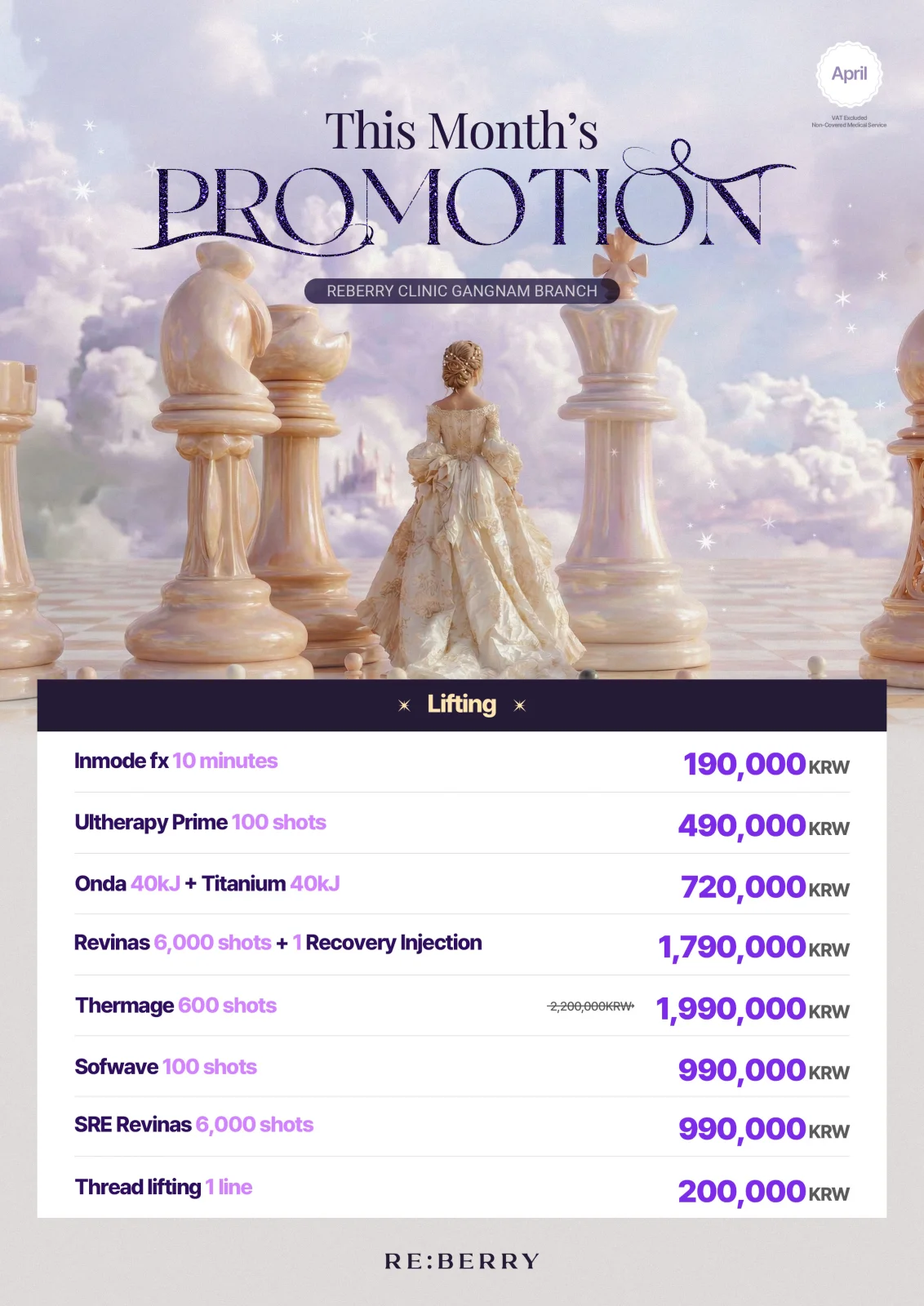
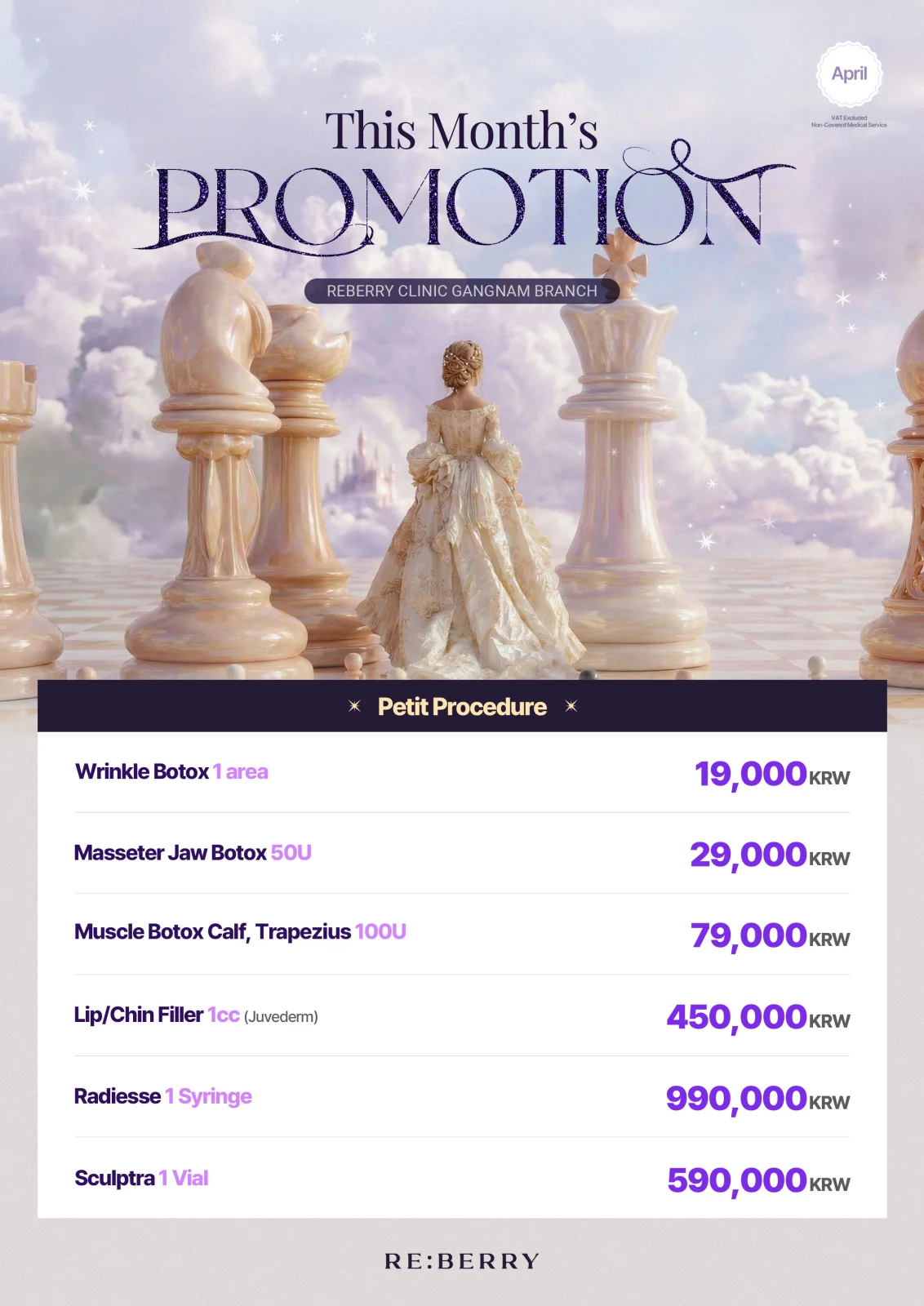
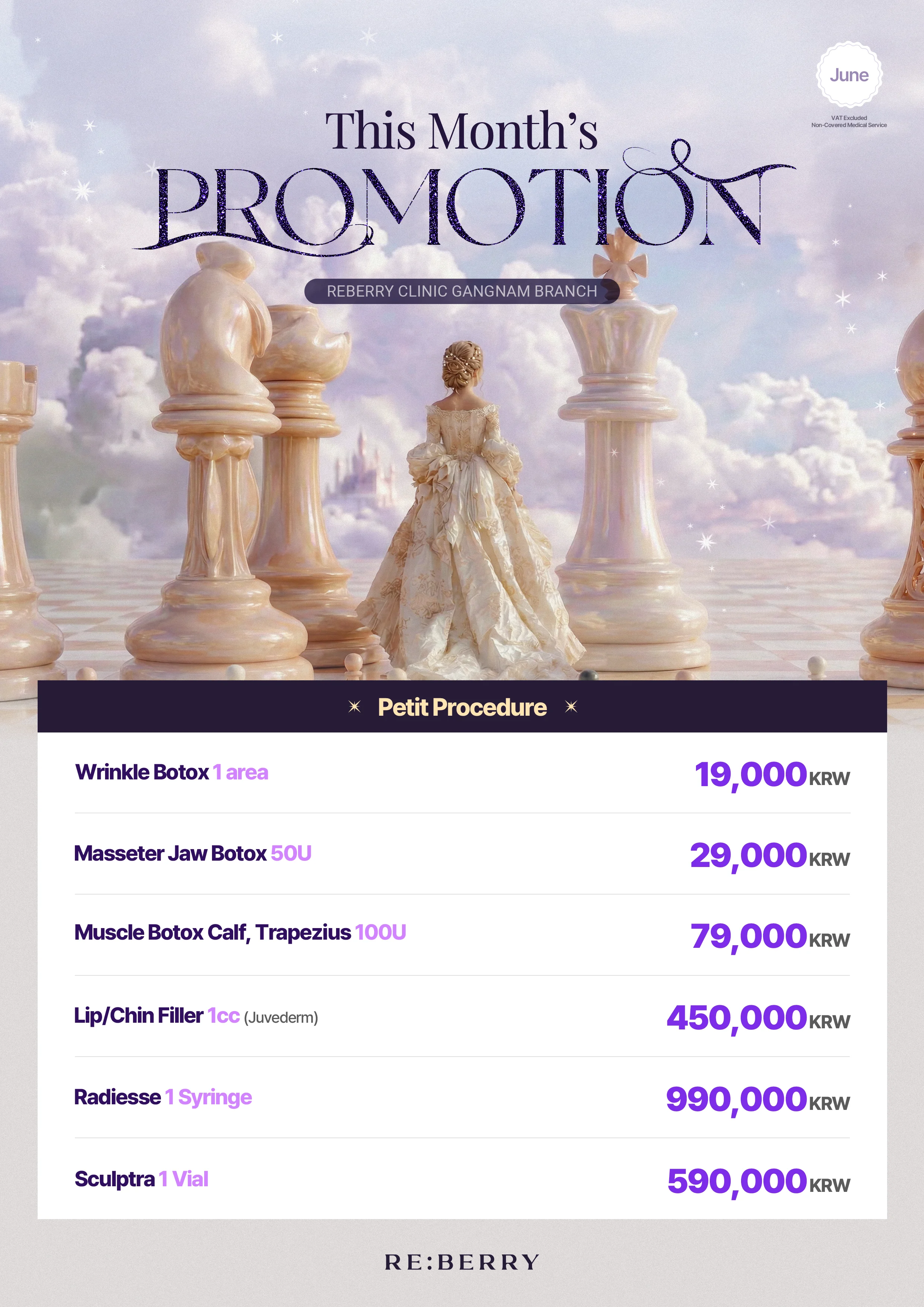
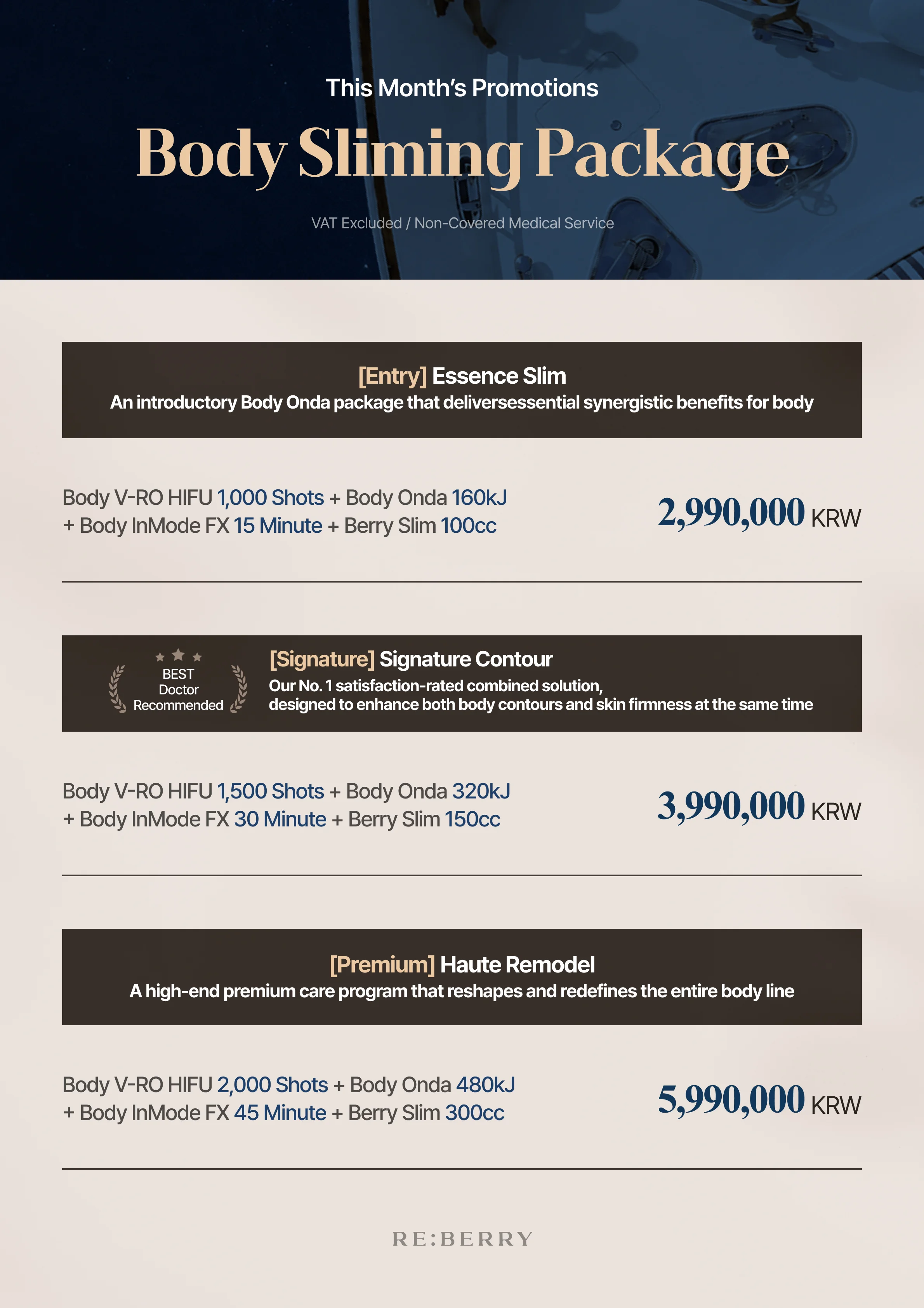
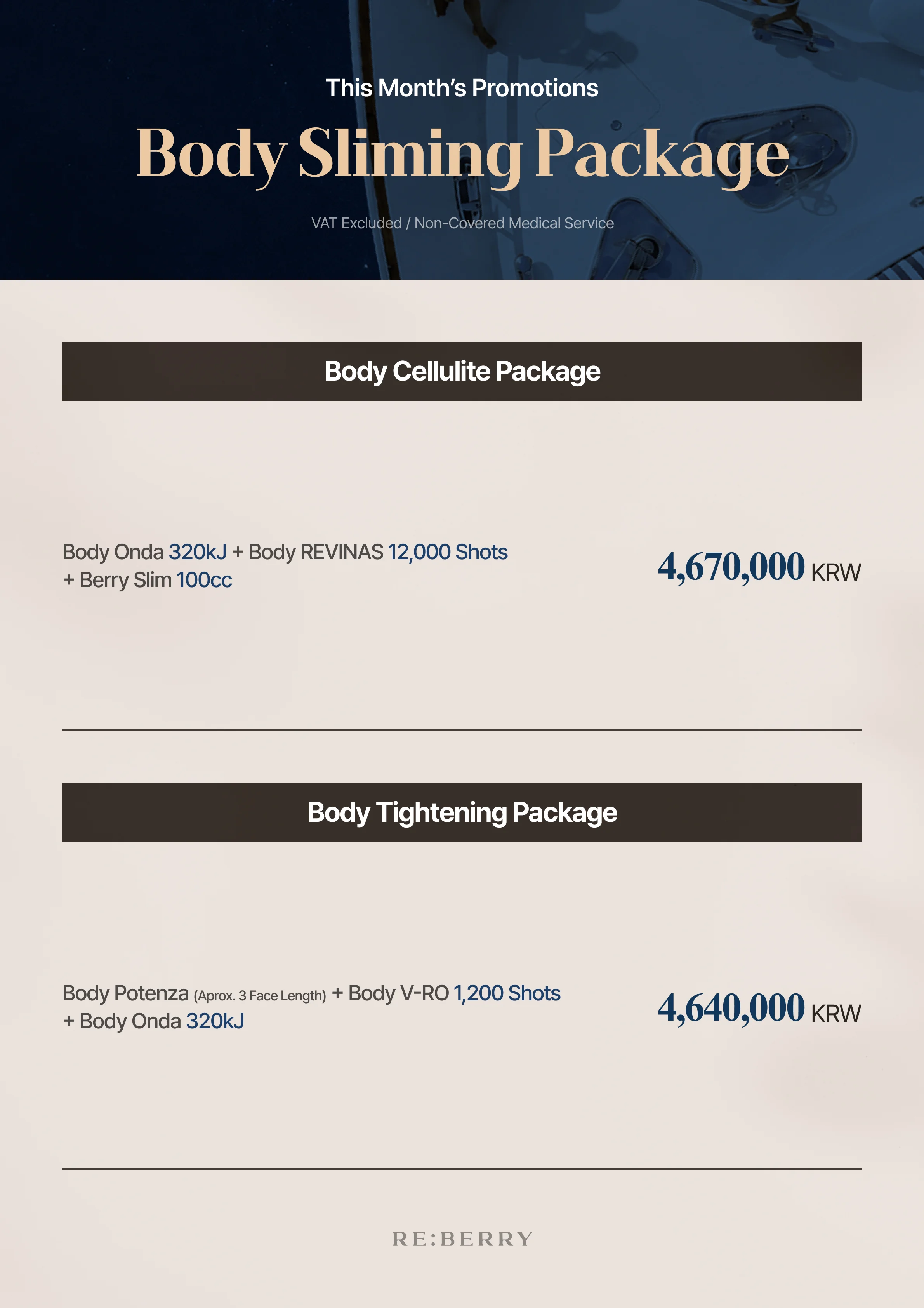
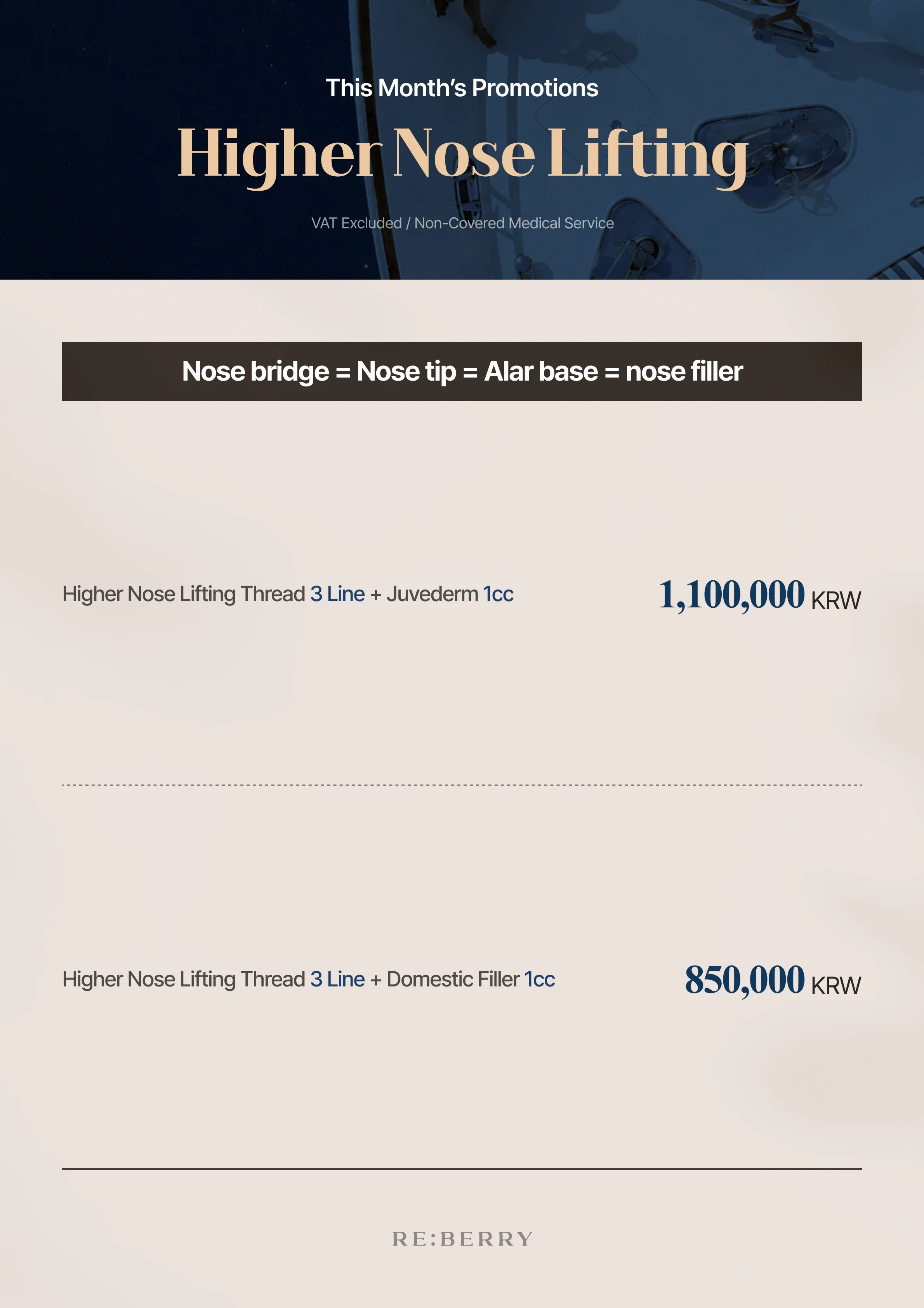
![RE:BERRY Gangnam October–December 2026 Promotion Page 10 — Body Slimming Package: [Entry] Essence Slim, an introductory Body Onda package that delivers essential synergistic benefits for body shaping and contouring: Body V-RO HIFU 1,000 Shots + Body Onda 160kJ + Body InMode FX 15 Minute + Berry Slim 100cc ₩2,990,000 · [BEST · Doctor Recommended] Signature Contour, our No. 1 satisfaction-rated combined solution, designed to enhance both body contours and skin firmness at the same time: Body V-RO HIFU 1,500 Shots + Body Onda 320kJ + Body InMode FX 30 Minute + Berry Slim 150cc ₩3,990,000 · VAT excluded](https://cdn-reberry.pages.dev/gangnam/promotion/en/gangnam-event-en-10.webp)
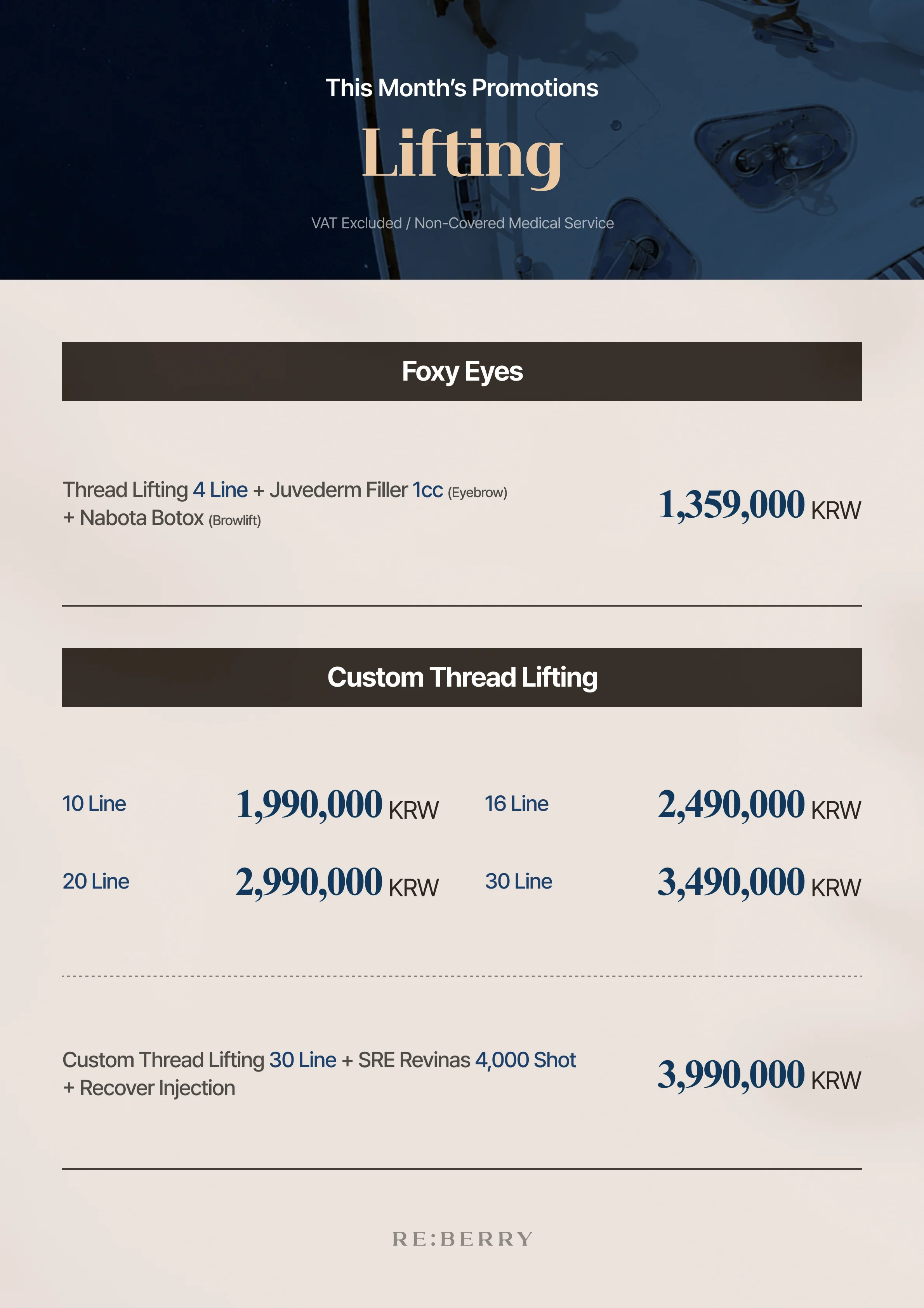
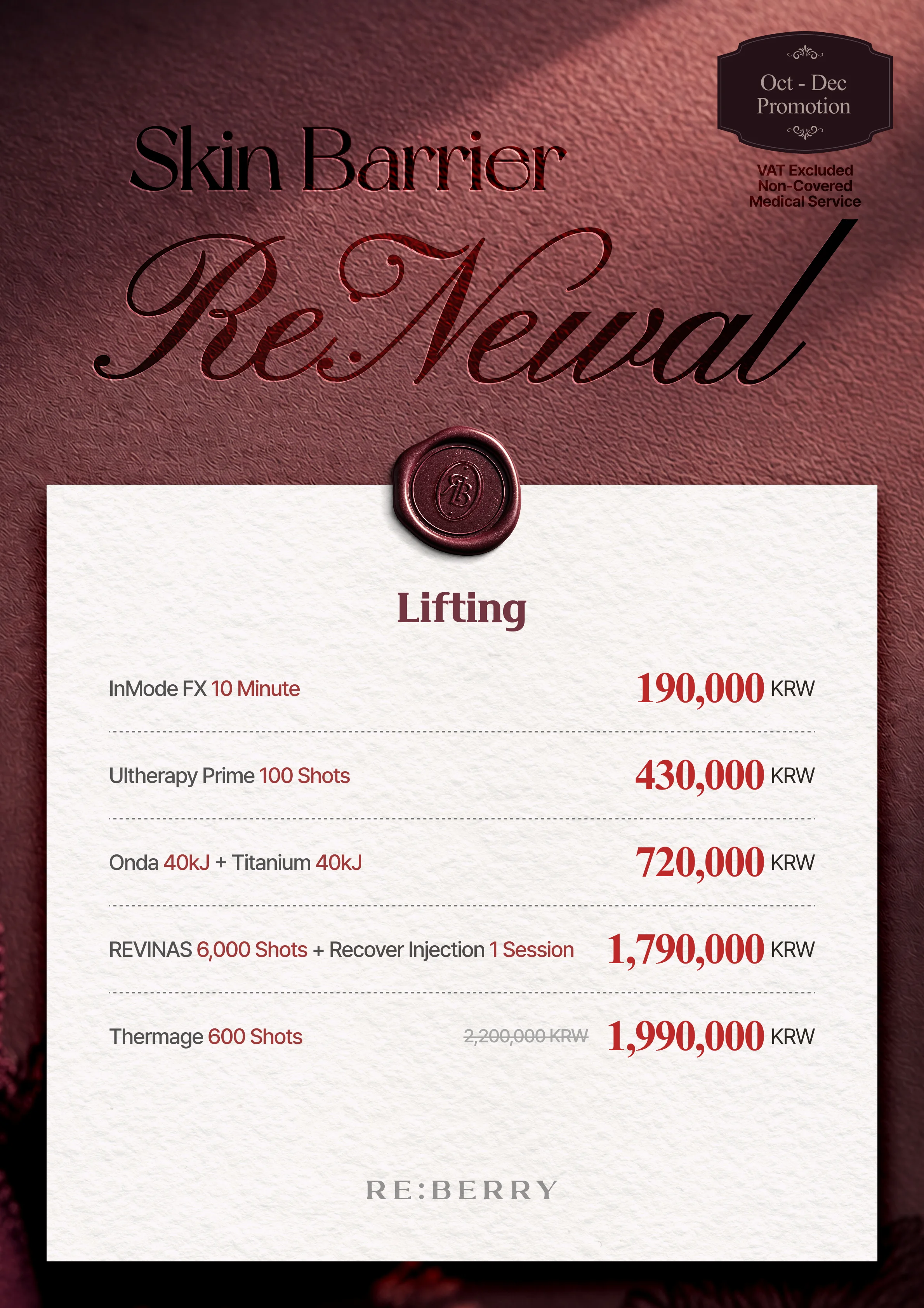
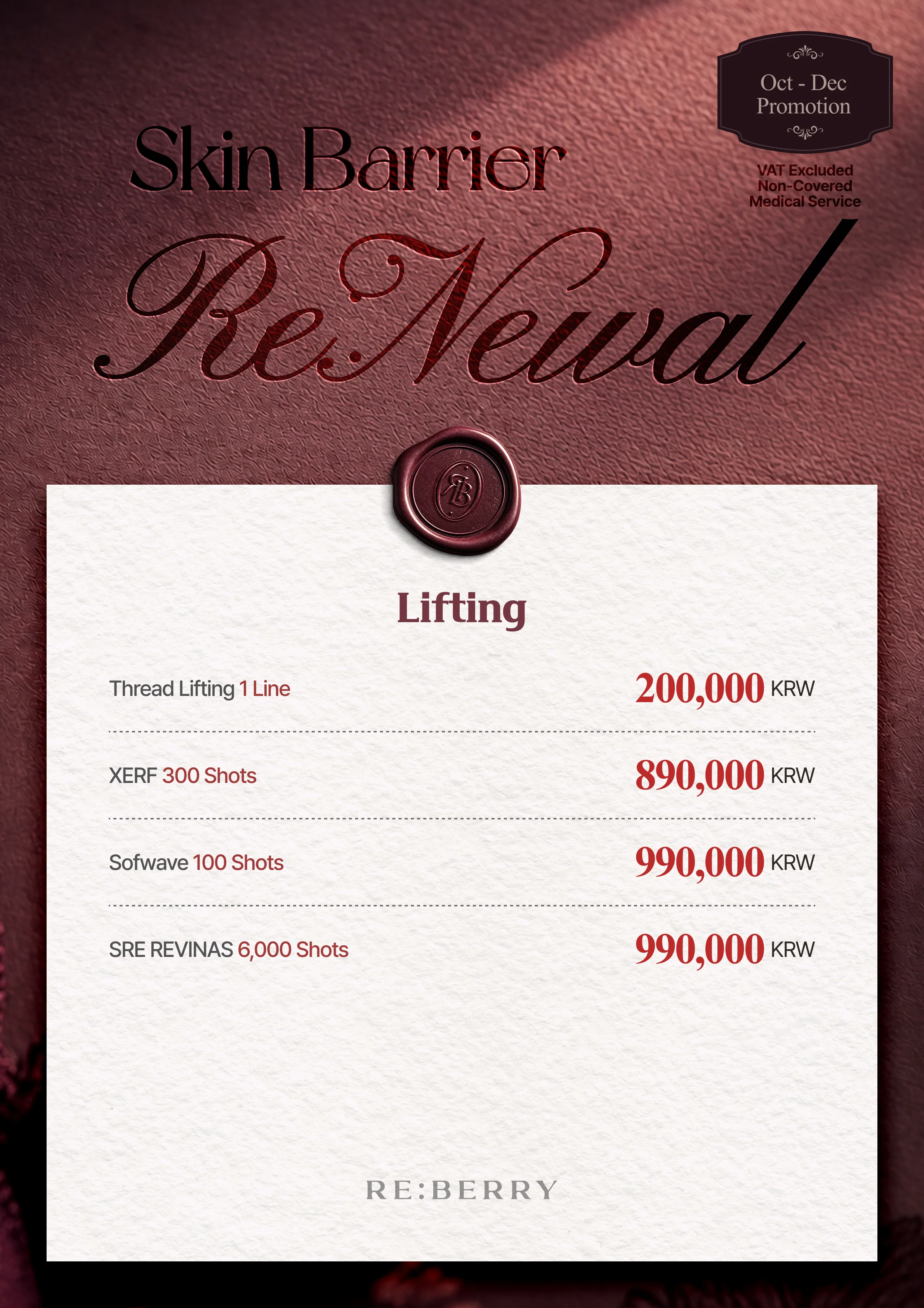
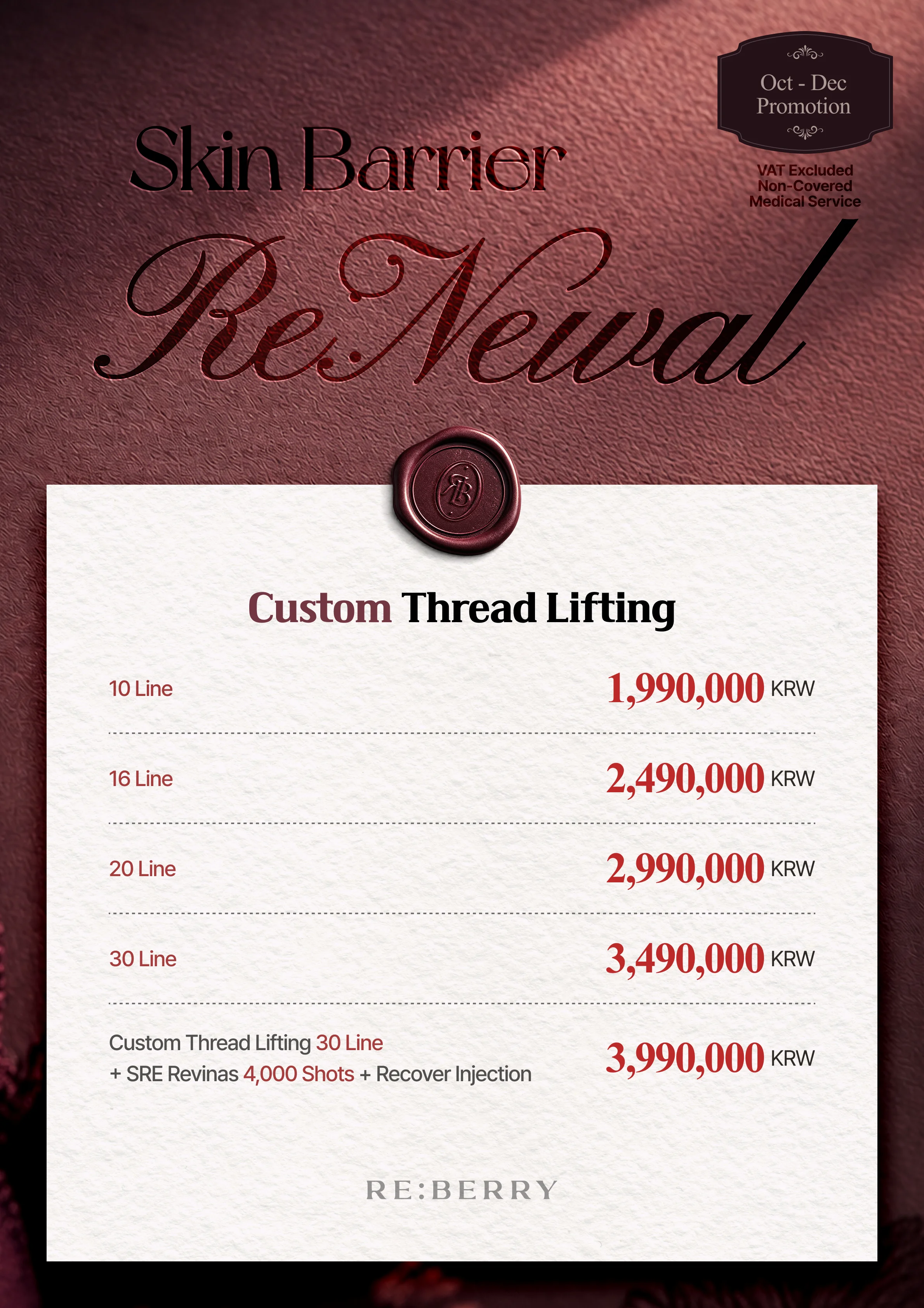
Published Whitening Laser Prices in Gangnam (Regular Rates, VAT Excluded)
Your Medical Director
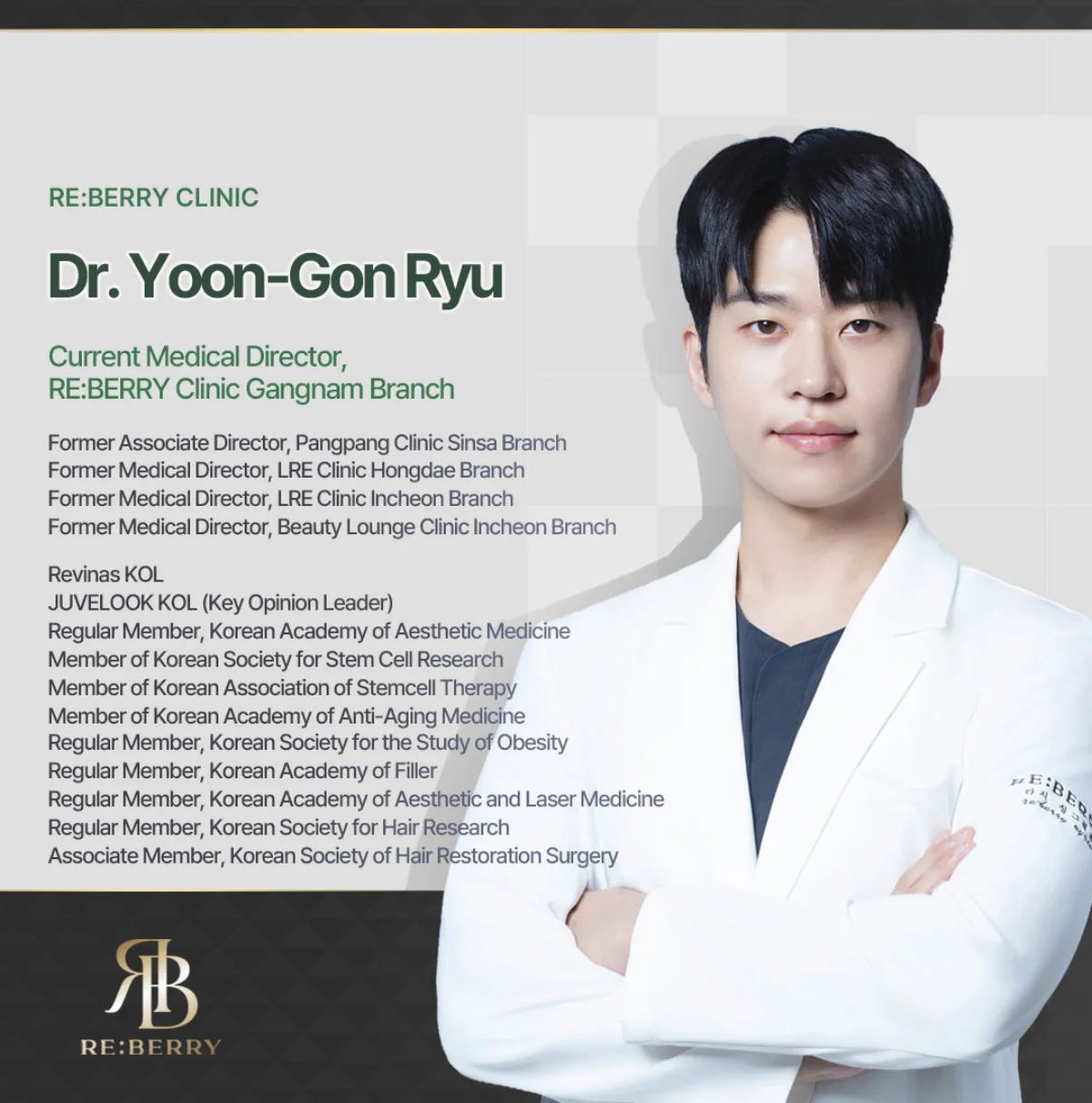
Dr. Yoon-Gon Ryu
- Medical Director, RE:BERRY Aesthetic Clinic Gangnam — Korean MOHW Medical License No.131644
- Manufacturer-appointed KOL invited to teach injection and energy-device technique to Korean peers
- Regular Member, Korean Academy of Aesthetic Medicine
- Co-manages every case with Dr. Yejin Oh (Korean MOHW Medical License No.144238)
- Featured in Authority Magazine (2026)
Medically reviewed by Dr. Yoon-Gon Ryu, CEO / Medical Director, RE:BERRY
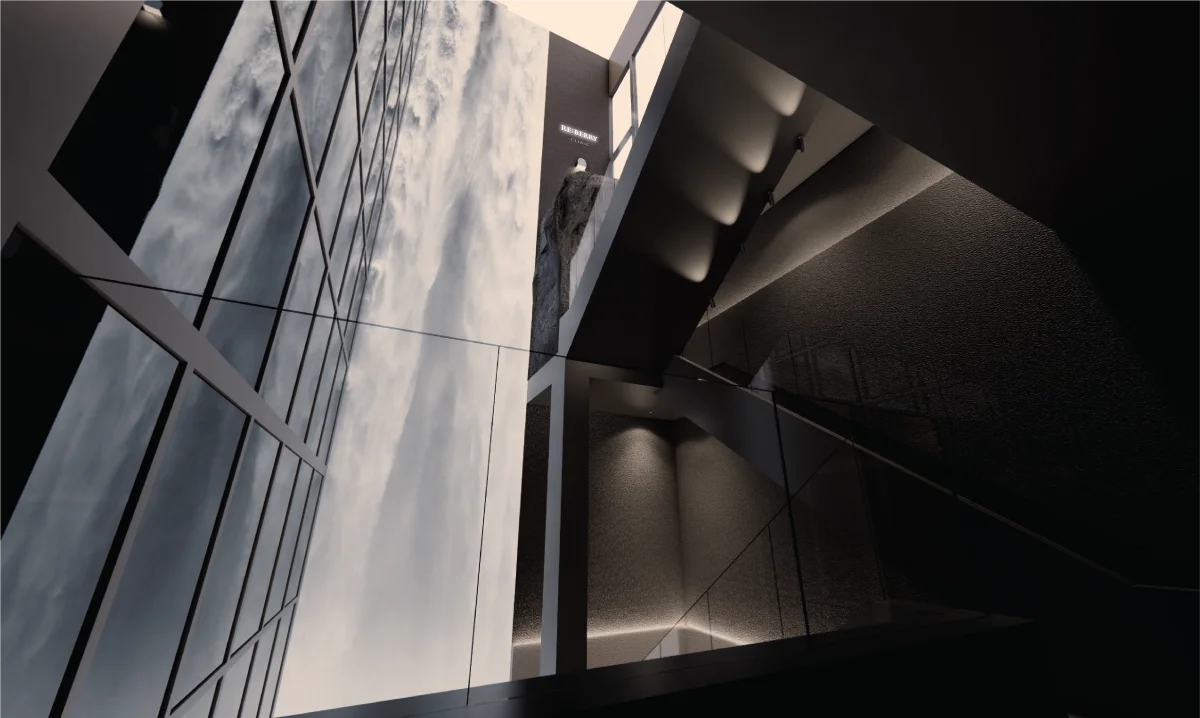
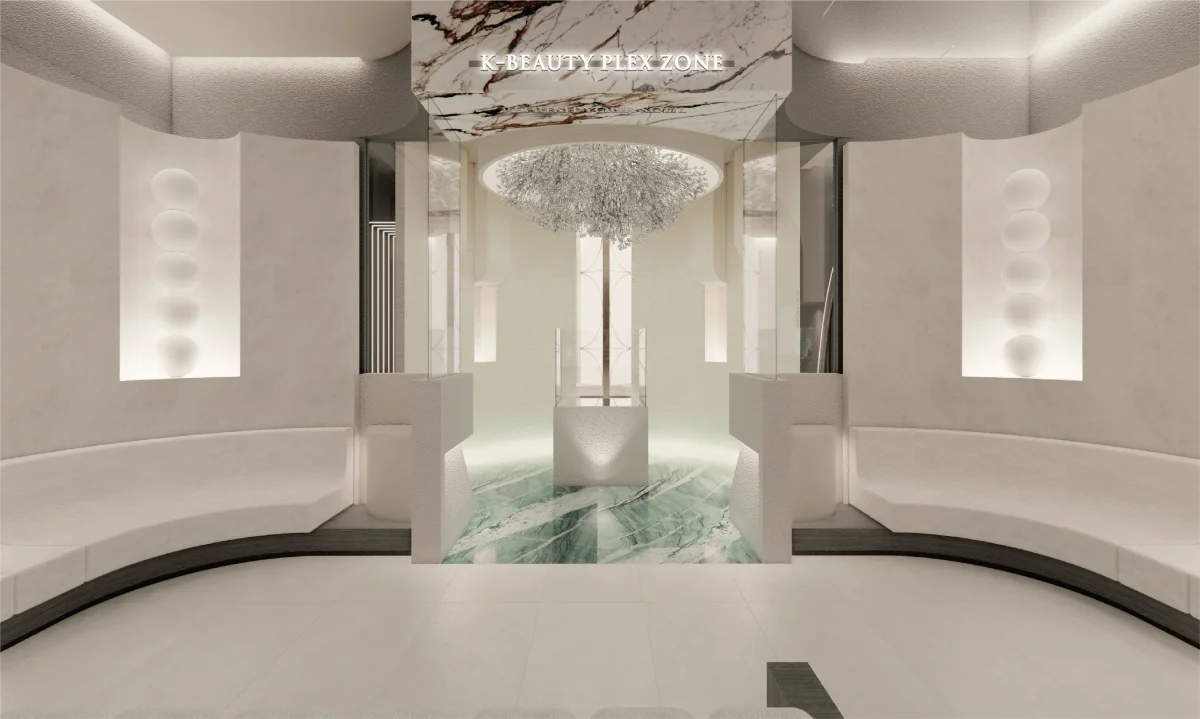
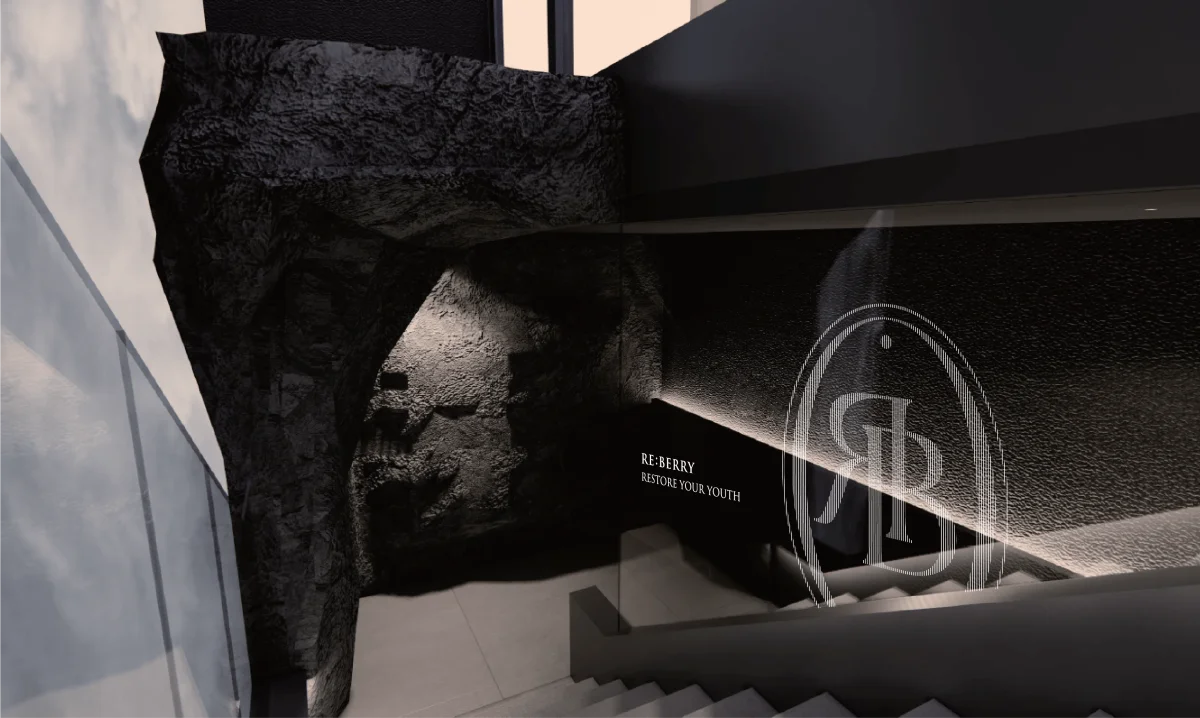
A Fourteen-Thousand-Square-Foot Hush Above Gangnam-daero
Step past the black gallery facade and the bustle of Gangnam-daero falls away. Fourteen thousand square feet of hushed corridors, marble installations, a cascading water feature and fully enclosed consultation suites — arranged so you rarely cross paths with another guest, because our appointment-first diary keeps every hour deliberately underbooked.
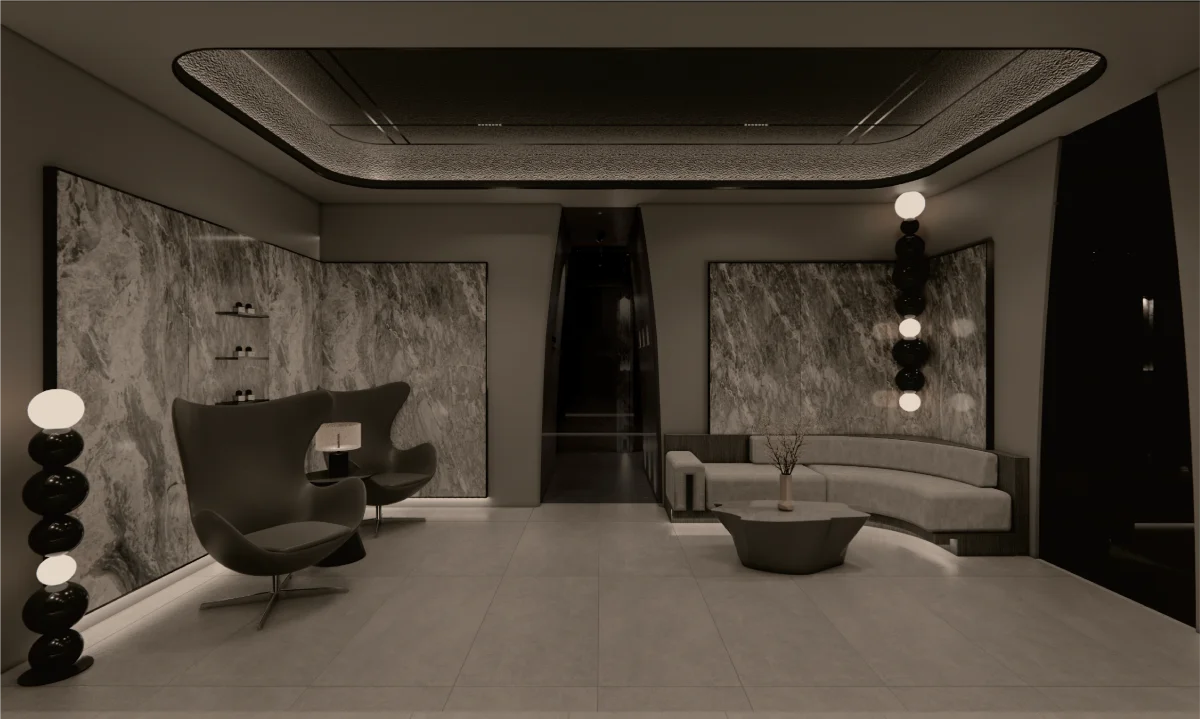
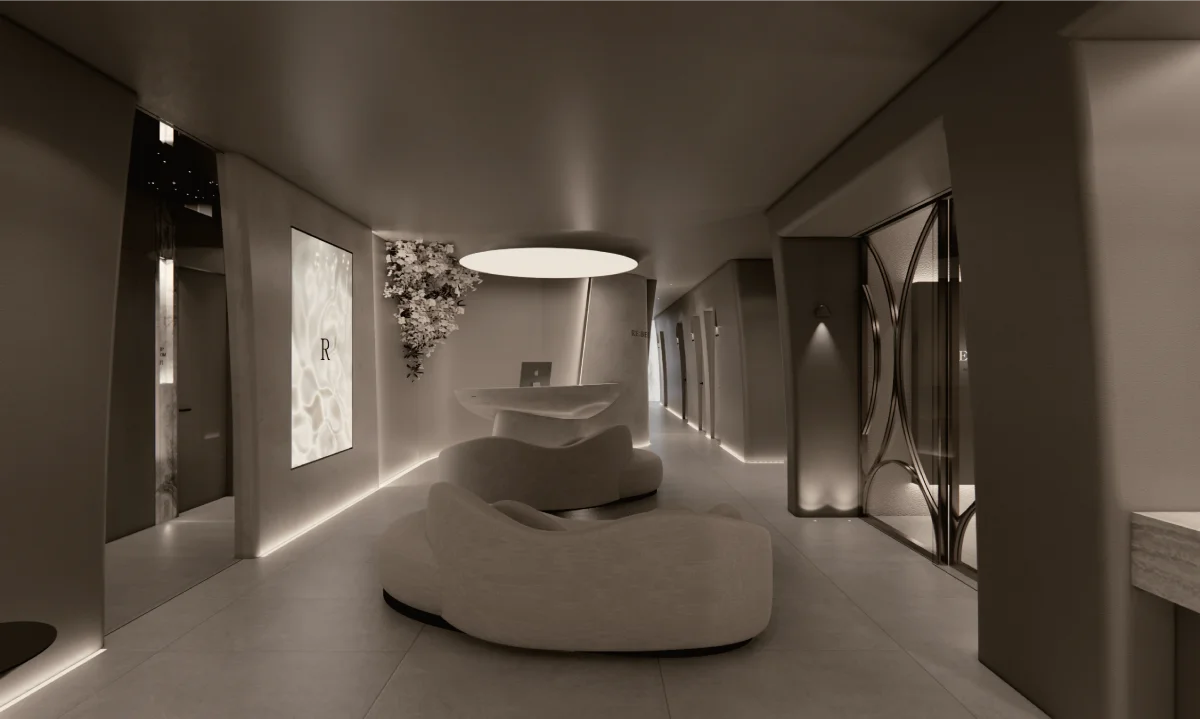
(1,322 m²)
Suites
KI Tower, Gangnam-daero
Station Exit 10
The Evidence Behind How a Whitening Laser Works
The whole mechanism traces back to one idea: selective photothermolysis. Anderson and Parrish set it out in 1983: choose a wavelength a target absorbs far more strongly than everything around it, hold the pulse shorter than the time that target needs to shed its heat, and the injury is confined to the target alone. Melanin is the target for a whitening laser, and it absorbs 755nm and 1064nm light many times more readily than the surrounding water-rich tissue, which is exactly what lets surplus pigment fracture while the skin in front of it stays cool.
Anderson RR, Parrish JA. Selective photothermolysis: precise microsurgery by selective absorption of pulsed radiation. Science. 1983;220(4596):524-527. doi:10.1126/science.6836297
Shortening the pulse from nanoseconds to picoseconds changes how the energy behaves. A systematic review of picosecond lasers in dermatology found that the ultrashort pulse acts more as a photoacoustic shock than a thermal burn, fracturing pigment into finer particles with less collateral heat, and reported meaningful clearance across pigmentary indications with a favourable safety profile. A split-face comparison of a picosecond alexandrite laser against a Q-switched Nd:YAG laser likewise recorded comparable or better pigment clearance from the picosecond device with fewer adverse events, supporting the shift to picosecond toning for pigment care.
Wu DC, Goldman MP, Wat H, Chan HHL. A systematic review of picosecond laser in dermatology: evidence and recommendations. Lasers Surg Med. 2020;53(1):9-49. doi:10.1002/lsm.23244
Lee YJ, Shin HJ, Noh TK, Choi KH, Chang SE. A split-face study: comparison of picosecond alexandrite laser and Q-switched Nd:YAG laser in the treatment of facial pigmentation. Lasers Med Sci. 2018;33(8):1733-1738. doi:10.1007/s10103-018-2529-2
Evidence in Asian and pigment-prone skin matters for a Seoul clinic, because the same energy that clears a fair complexion can inflame a deeper one. A study of a picosecond laser combining 1064nm and 595nm wavelengths reported effective pigment reduction with a low incidence of post-inflammatory change when fluence was kept controlled. The physician at RE:BERRY Gangnam runs a retroauricular test and low settings on deeper phototypes for the same reason. A review of laser and light therapy in melasma reinforces the caution: melasma responds to gentle, low-fluence protocols and strict sun control, and is managed over the long term as an ongoing condition. That literature is the reason a whitening laser here is paced to biology, following the body's clearance clock.
Choi YJ, Nam JH, Kim JY, et al. Efficacy and safety of a novel picosecond laser using combination of 1064 and 595 nm on patients with melasma. Lasers Surg Med. 2017;49(10):899-907.35
Trivedi MK, Yang FC, Cho BK. A review of laser and light therapy in melasma. Int J Womens Dermatol. 2017;3(1):11-20. doi:10.1016/j.ijwd.2017.01.004
How a Whitening Laser Works — Questions International Guests Ask
How does a skin whitening laser actually remove pigment?
It works by selective absorption. The laser fires a wavelength that melanin takes up far more strongly than the surrounding skin, so the pulse travels through the surface, is soaked up by the surplus pigment, and fractures it into tiny particles while the neighbouring tissue stays cool. Your own cells then clear those particles over the following weeks. Nothing is bleached and nothing is sanded away, and the pigment is simply broken at its source so the body can flush it out.
Why does a whitening laser take several sessions to work?
Because breaking the pigment is fast but removing it is not. A single pass fractures the melanin in minutes, but the fragments are carried out of the skin by your dermal macrophages over roughly two to four weeks. Each low-fluence pass can only clear what it can safely reach, so the tone evens in thin layers across a course of visits spaced three to four weeks apart. Trying to skip visits by turning the energy up is exactly what provokes reactive skin to rebound darker.
What does the laser mean when it says it targets melanin?
Melanin is the brown pigment that clumps unevenly in sun spots, freckles, and melasma. The laser wavelength is chosen because melanin absorbs it many times more readily than the water-rich tissue around it. That difference in absorption is the whole point: the energy is soaked up where the pigment sits and largely passes through everything else, so the melanin fractures while the surrounding skin is spared.
What is the difference between picosecond and nanosecond pulses?
It comes down to how brief the pulse is. A picosecond pulse lasts trillionths of a second, shorter than the time a melanin particle needs to shed its energy, so the energy lands as a mechanical photoacoustic shock that shatters pigment into finer fragments with far less heat spreading into the skin. A nanosecond pulse is longer and leans more on heat. The shorter pulse is what makes modern toning gentle enough to repeat on sensitive pigment.
Why are different wavelengths like 755nm and 1064nm used?
Different pigment lives at different depths, and each wavelength reaches a different distance into the skin. A 755nm picosecond beam suits shallow, defined spots near the surface. A 1064nm pulse penetrates deeper to reach the dermal pigment behind melasma or Hori's nevus, and it is held at low fluence to keep that deeper work gentle. The physician reads where your pigment sits first, then matches the wavelength to that depth, adjusting it zone by zone across the face.
Can a whitening laser make my overall skin lighter than my natural tone?
No. A physician reading your pigment will say the same at the first visit. A whitening laser moves the surplus melanin sitting over your baseline: the sun spots, the marks, the diffuse dullness. It does not touch the tone you were born with. The goal is an even, clearer version of your own complexion. Setting that expectation is the first thing done at the reading.
Does it hurt, and is there any wound or crust?
Most guests feel a light warmth with a faint snapping sensation, and because the energy passes through intact skin without cutting it, there is no wound and usually no crust. A faint pinkness settles within two to four hours. Some shallow spots may briefly darken and flake over a few days as the pigment lifts, which is a normal part of clearance and not a complication.
How does the pigment leave my skin after the laser breaks it?
Your own immune cells do the removal. Once the laser fractures the melanin into sub-micron particles, dermal macrophages recognise the debris and ferry it out of the skin over roughly fourteen to twenty-eight days. This is why the brightening keeps arriving in the weeks between appointments, spread out well past treatment day, and why the schedule is paced to that natural clearance window.
Why is melasma treated so cautiously with a whitening laser?
Melasma is heat- and light-sensitive pigment that darkens easily when provoked. Push the fluence too high and it rebounds worse than before, so the physician keeps the energy deliberately low, spaces the passes wide, and pairs the laser with strict sun protection. The peer-reviewed literature on melasma supports exactly this gentle approach. Melasma is managed as an ongoing plan across many gentle sessions, and RE:BERRY sets out that plan before the first whitening pass.
Does a whitening laser do anything besides fade pigment?
There is a modest secondary effect. The mild thermal stimulation that rides along with the toning wavelength gives the dermis a low-grade nudge toward collagen, so over a course treated skin often reads a touch smoother and pores look slightly tighter alongside the more even tone. It is a useful bonus that arrives with the wavelength already being used for pigment, and at RE:BERRY Gangnam it is never itemized as a separate service.
How soon will I see a difference, and how long does it last?
Surface dullness usually lifts first, so the complexion can read a shade clearer within a week or two as the freshest epidermal layer turns over. Diffuse pigment and stubborn marks lighten more gradually across the course. Once your target tone is reached, daily sun protection and the occasional upkeep pass hold it, since ultraviolet re-stimulates the same melanin the laser cleared, so your daily sun habits, more than the laser alone, decide how long the result stays.
How much does a whitening laser session cost at RE:BERRY Gangnam?
The regular published rate is ₩100,000 (about $71), VAT excluded, shown before you book. Because the treatment is planned as a course paced to your pigment clearance, the physician confirms how many passes your reading is likely to need at consultation, so you know the shape of the plan before anything is scheduled.
How do I book, and where exactly is the clinic?
Message RE:BERRY on WhatsApp with your pigment concerns and travel dates, and a coordinator replies in English as soon as possible to confirm the ₩100,000 (about $71) rate in writing and reserve a physician slot. The clinic sits inside KI Tower on Gangnam-daero, a two-minute walk from Gangnam Station Exit 10 on Seoul Metro Line 2, roughly 45 to 60 minutes from Incheon Airport by AREX plus subway.
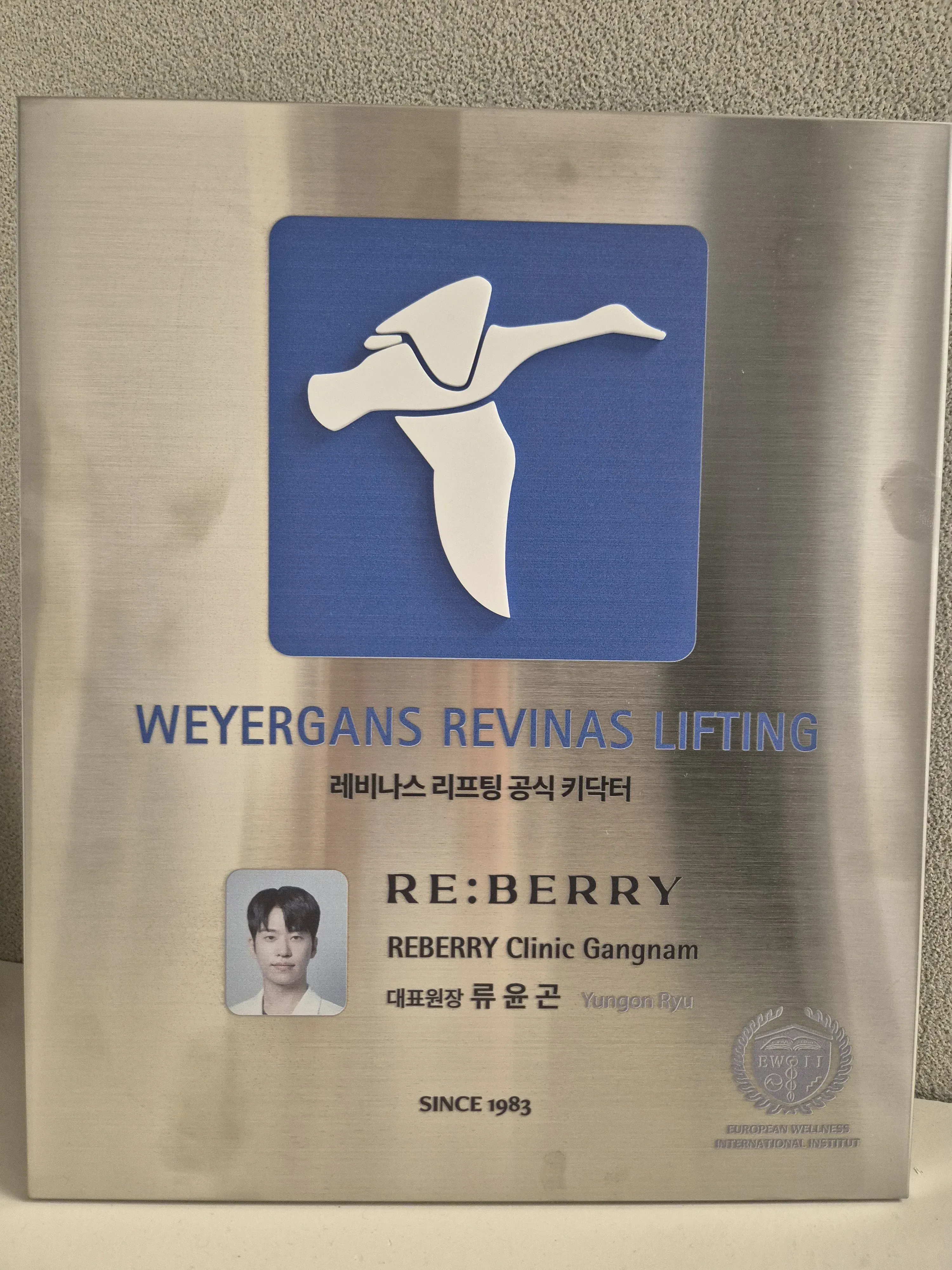
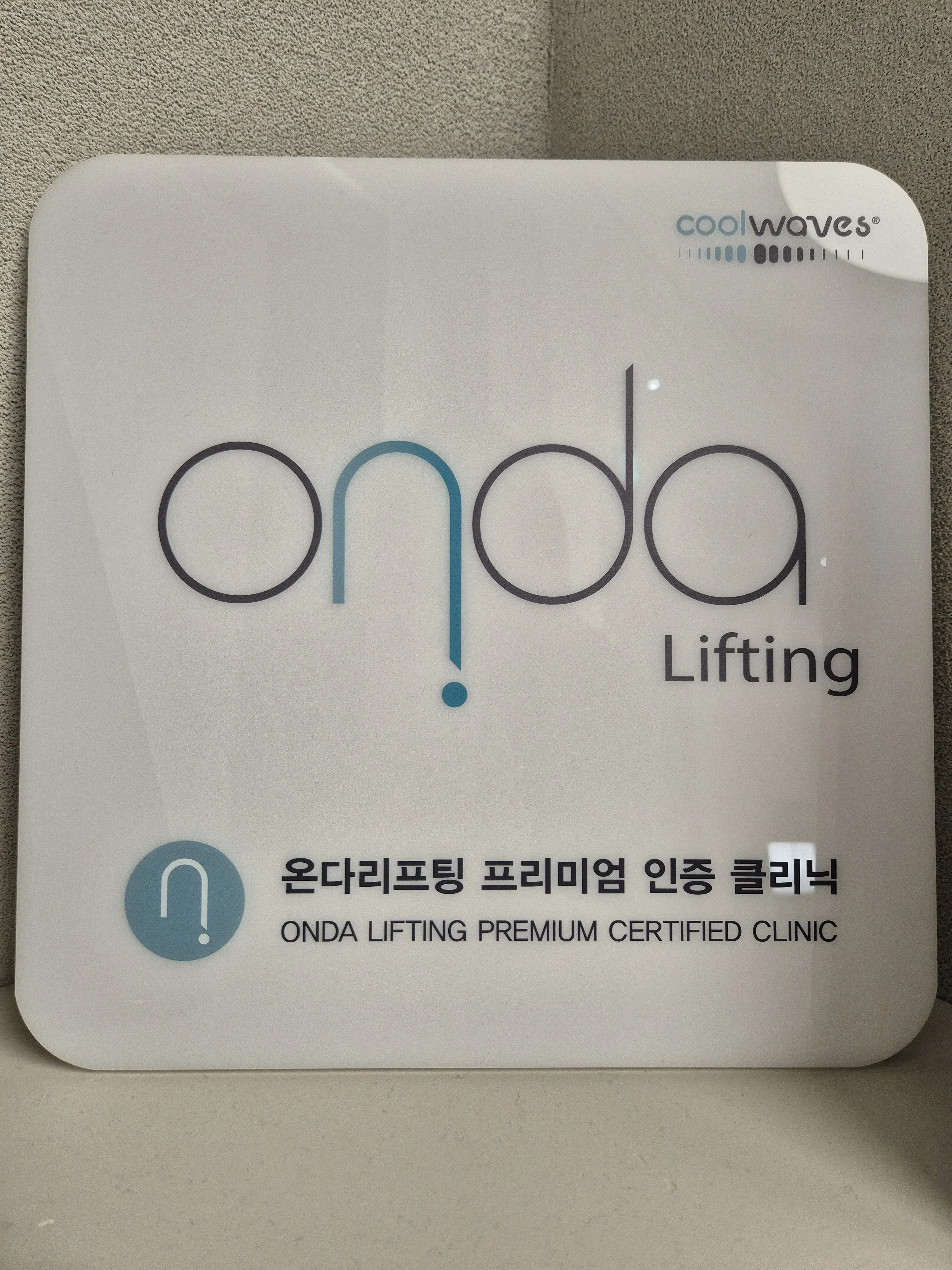
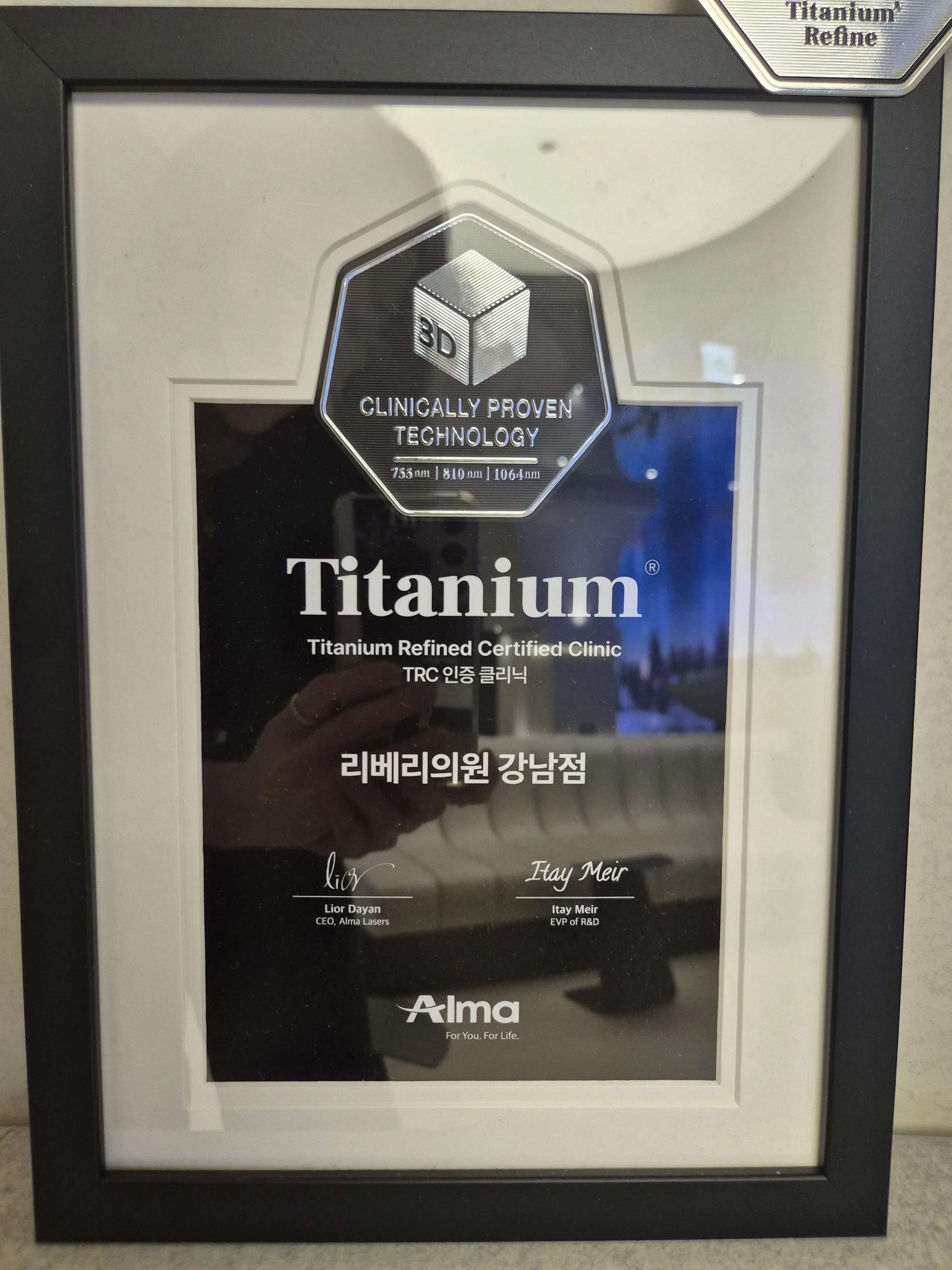
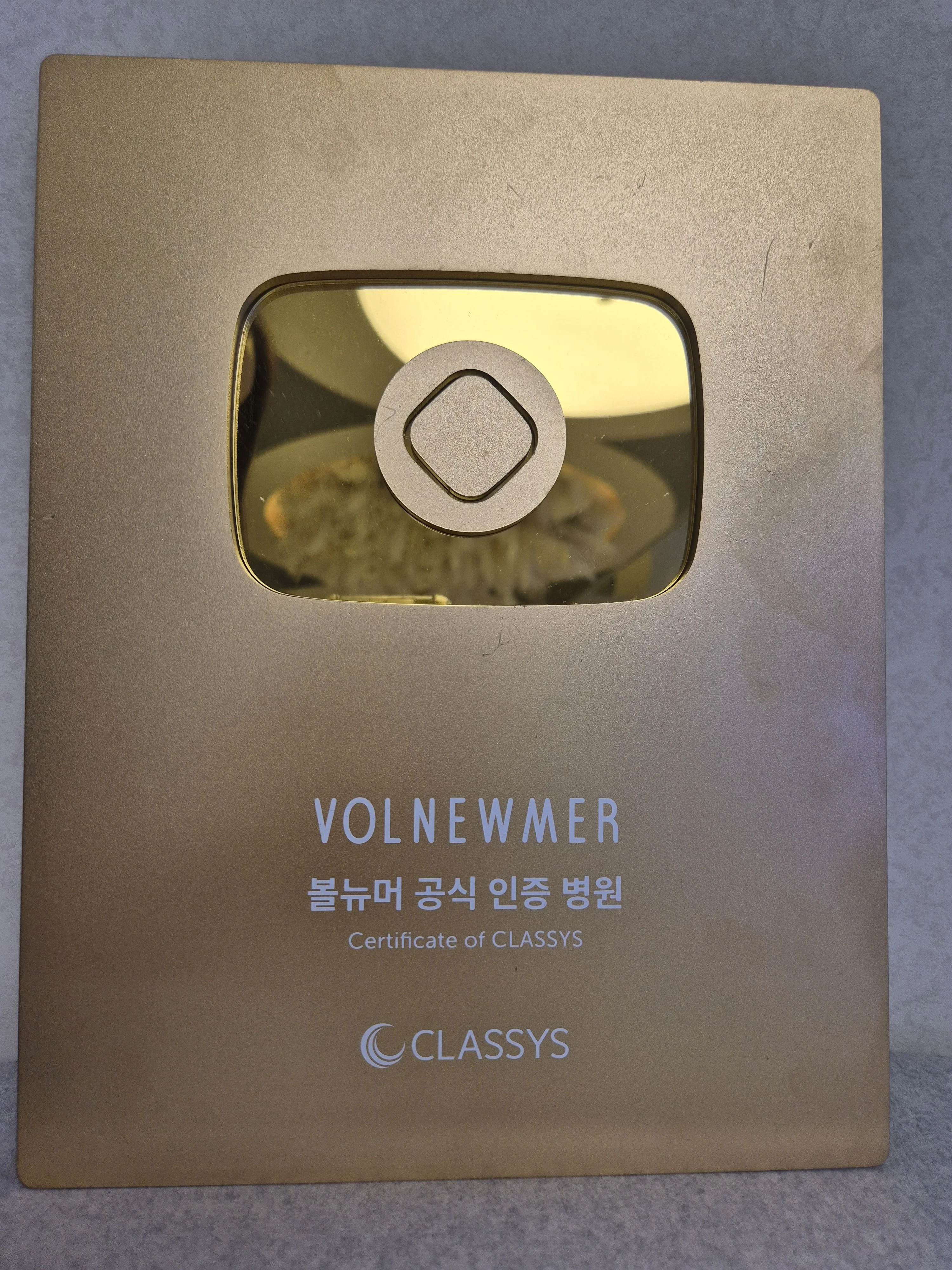
Only Authentic, Brand-Certified Equipment
Every device at RE:BERRY is MFDS-certified and manufacturer-verified. We never use counterfeit or grey-market equipment.
Ask a Physician How a Whitening Laser Would Work for Your Pigment
Send your pigment concerns and travel dates to RE:BERRY on WhatsApp — a coordinator replies as soon as possible, and the physician reads your skin before naming a realistic target and the ₩100,000 (about $71) rate in writing. The doctor who reads your pigment sets the wavelength, delivers every pass, and tracks the fade, and nothing is scheduled until you confirm.
Related Treatments
Why Tens of Thousands of Foreign Patients Are Choosing This Gangnam Clinic — Business Wire, 2026-04-13
Numbers That Tell Our Story
Cumulative across RE:BERRY clinics (Gangnam · Myeongdong · Incheon Airport).
Brand-Authenticated Equipment & Training




Our doctors are certified by Korea's top dermatological societies






Latest from Our Instagram
Real treatments, patient reactions, and behind-the-scenes from RE:BERRY.
Tap any video for sound & fullscreen
What our patients say
Real verified reviews from our Google Business Profile
I had a really nice experience at Reberry Clinic Gangnam. I received a Hydrafacial treatment, and the whole process was very comfortable. The staff were kind and explained everything clearly, and the clinic itself felt clean and relaxing. I also loved the interior — the clinic felt very clean, elegant, and luxurious, w...
I had such an amazing experience at this clinic! The clinic itself is absolutely stunning the design is beautiful, elegant, and luxurious, and the service is truly top-notch. Everything was so well organized, and I felt very comfortable from the moment I walked in.
I had a Korean filler treatment to reduce my nasolabia...
i had a good time having the Juvelook treatment!
It was my first time in Korea, all the Doctor & team are bery helpful. Dr. Ian & cheong a lee(jenny) are really helpful.
I understand more about my skin.
The clinic is calm, welcoming.
there are many activities i didn’t expect to find in a beauty clinic; phot...
So happy to found the beauty clinic in Korea that very inclusive and Muslim friendly. They have a prayer space for muslim and they prepare a female doctor for me. The clinic is so comfortable with aesthetic design make me feel relaxed. The doctor and the staff are very professional and helpful so all of the procedure r...
As someone who has struggled with acne since middle school, I decided to stop here during a layover in Seoul and was amazed by the treatment.
Firstly, the environment is elegant and peaceful. Feels very luxurious and the treatment from staff was as such as well. Speaking of staff, they were extremely professional, car...
Book Your Personalized Consultation
Share your details and our multilingual team will contact you as soon as possible through your preferred messenger.
- ✓ Free online skin consultation with a doctor
- ✓ Personalized treatment plan & pricing
- ✓ 5-language support (EN/ZH-CN/ZH-TW/JA/ES)
- ✓ Response as soon as possible via your preferred messenger
Science How a whitening laser works — peer-reviewed references
The mechanism behind a whitening laser rests on a principle established in 1983: Anderson and Parrish described selective photothermolysis, confining injury to a chromophore by pairing a well-absorbed wavelength with a pulse shorter than the target's thermal relaxation time (Anderson 1983). Melanin is that chromophore for pigment lasers. Shortening the pulse into the picosecond domain shifted the dominant effect from heat to photoacoustic fracture, and a systematic review across pigmentary indications documented finer particle breakup with less collateral heat (Wu 2020), while a split-face trial found picosecond clearance comparable or superior to Q-switched Nd:YAG with fewer adverse events (Lee 2018). In pigment-prone skin the caution is evidence-led: a controlled-fluence picosecond study reported effective reduction with low post-inflammatory change (Choi 2017), and a review of laser and light therapy in melasma confirmed that gentle, low-fluence protocols with strict photoprotection manage the condition over time as a long-running plan (Trivedi 2017). Read together, this literature explains why RE:BERRY Gangnam paces the passes to the body's clearance and keeps deeper phototypes at conservative settings.
- Anderson RR, Parrish JA. Selective photothermolysis: precise microsurgery by selective absorption of pulsed radiation. Science. 1983;220(4596):524-527. doi:10.1126/science.6836297
- Wu DC, Goldman MP, Wat H, Chan HHL. A systematic review of picosecond laser in dermatology: evidence and recommendations. Lasers Surg Med. 2020;53(1):9-49. doi:10.1002/lsm.23244
- Lee YJ, Shin HJ, Noh TK, Choi KH, Chang SE. A split-face study: comparison of picosecond alexandrite laser and Q-switched Nd:YAG laser in the treatment of facial pigmentation. Lasers Med Sci. 2018;33(8):1733-1738. doi:10.1007/s10103-018-2529-2
- Choi YJ, Nam JH, Kim JY, et al. Efficacy and safety of a novel picosecond laser using combination of 1064 and 595 nm on patients with melasma. Lasers Surg Med. 2017;49(10):899-907.35
- Trivedi MK, Yang FC, Cho BK. A review of laser and light therapy in melasma. Int J Womens Dermatol. 2017;3(1):11-20. doi:10.1016/j.ijwd.2017.01.004
These references shape how a whitening laser is delivered at RE:BERRY's Gangnam aesthetic clinic: pigment reading and a realistic target before any energy; wavelength matched to depth with conservative fluence on deeper phototypes; and passes paced to the two-to-four-week macrophage clearance window under the same licensed physician. This information is for educational purposes only and is not medical advice.
How to Find RE:BERRY Gangnam
2 minutes from Gangnam Station Exit 10. B1–B2, KI Tower — the building with the all-black entrance you can't miss.
RE:BERRY Clinic Gangnam
B1–B2, KI Tower, 69-gil 8, Gangnam-daero, Seocho-gu, Seoul
서울시 서초구 강남대로69길 8, 지하1·2층 (KI타워)
Also available at: Myeongdong · Incheon Airport