The Truth About Medical Tourism in Korea: A Doctor’s Perspective
The Truth About Medical Tourism in Korea: A Doctor's Perspective
An Honest Conversation About Medical Tourism in Korea
I am going to tell you something that most clinic websites will not: medical tourism in Korea is not perfect. It is, on balance, an excellent option for many people. But the industry has real problems alongside its genuine strengths, and you deserve an honest assessment from someone who works inside it every day.
This is not a sales pitch. It is a frank discussion about what works, what does not, and how to make informed decisions about traveling to Korea for aesthetic treatments.
What the Industry Gets Right
The Technology Gap Is Real
Korean aesthetic clinics genuinely have access to more devices and treatment options than most clinics in the West. This is not marketing hyperbole. A well-equipped Gangnam clinic might have 15-20 different energy-based devices in regular rotation. A comparable US practice might have 4-6.
This matters because different skin concerns require different approaches. Having access to Ultherapy, Thermage, Sofwave, Revinas, Onda, Potenza, and Inmode under one roof means the doctor can choose the optimal device for your specific anatomy rather than fitting your problem to whatever machine the clinic happens to own.
Volume Creates Expertise
A busy Gangnam dermatology clinic performs 3,000-5,000 energy-based treatments per year. A typical US dermatology practice might perform 200-500. This volume difference translates directly into expertise. When your doctor has performed a procedure 2,000 times versus 100 times, the refinement of technique, the ability to handle complications, and the instinct for optimal settings are qualitatively different.
The Price Advantage Is Legitimate
Korean aesthetic treatments cost 40-70% less than equivalent procedures in the US, UK, Australia, or Japan. This is not because of lower quality. It is the result of extreme competition (1,500+ clinics in Gangnam alone), lower overhead costs, and domestically manufactured products. When Botox starts at ₩19,000 per area ($14), that is a real, sustainable price at a profitable clinic.
What the Industry Gets Wrong
The Broker System
This is the single biggest problem in Korean medical tourism, and most visitors do not know it exists. Here is how it works:
Medical tourism agencies, both online platforms and physical offices in tourist areas, connect international patients with clinics. The clinic pays the agency a commission for each patient, typically 30-50% of the treatment cost. This means:
- The agency recommends clinics based on commission rates, not quality
- The clinic must charge higher prices to cover the commission, or cut costs elsewhere
- The patient pays more than a walk-in would, often without knowing it
- The incentive structure rewards clinics that upsell aggressively
My advice: Contact clinics directly. Use their official websites, KakaoTalk, or WhatsApp channels. If you found a clinic through an agency, ask the clinic directly what the treatment would cost without the agency’s involvement. The difference can be 30-50%.
The Ghost Doctor Problem
This is well-documented in Korean media and has been the subject of government investigations. “Ghost surgery” occurs when the doctor who performs your consultation is not the doctor who actually performs your procedure. A substitute physician, sometimes a resident or less experienced doctor, takes over once you are under anesthesia or sedation.
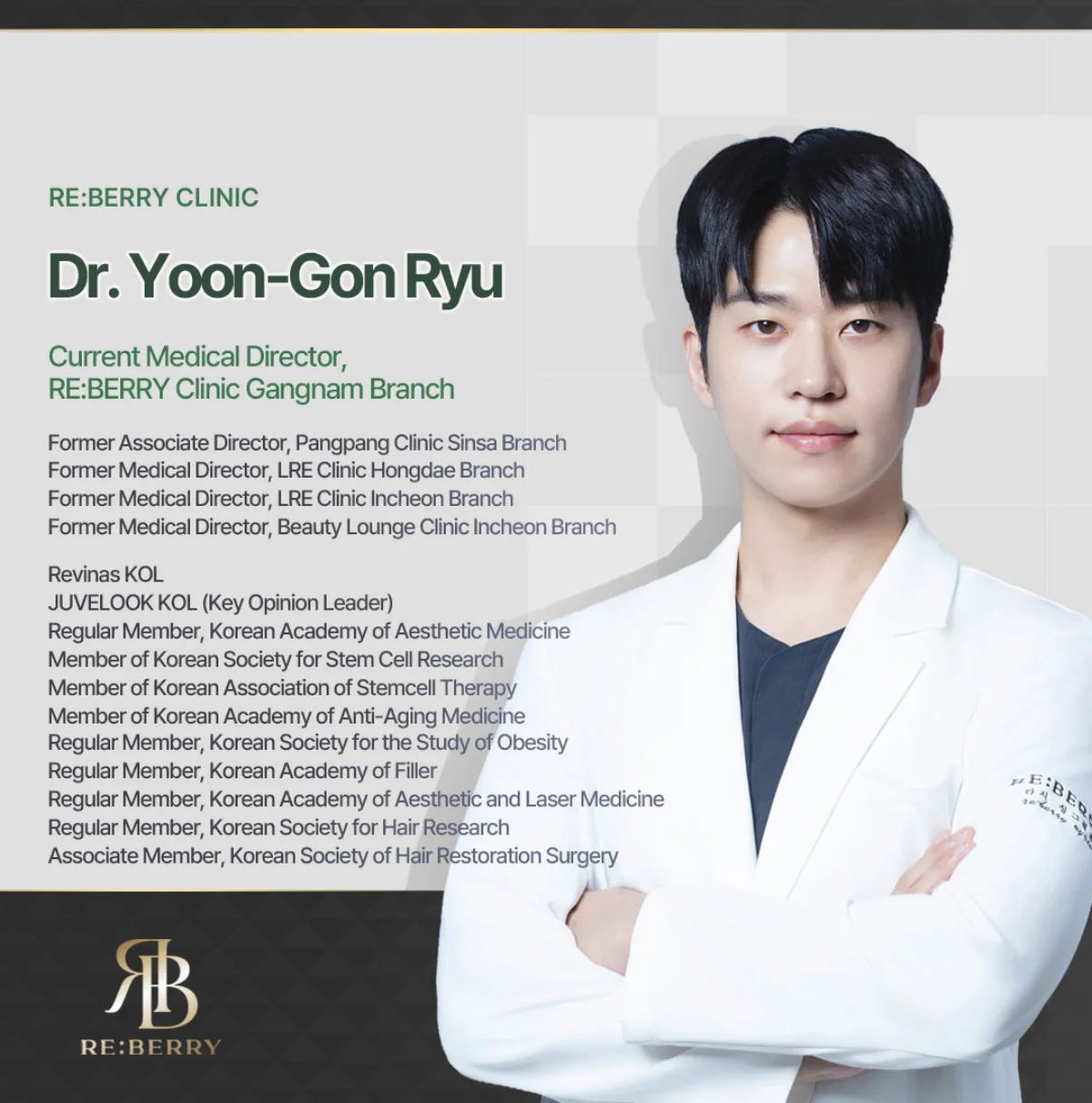
This is primarily a problem in plastic surgery (where general anesthesia is involved) rather than non-surgical aesthetic treatments. However, it is worth asking directly: “Will the doctor I am consulting with perform my treatment?” At RE:BERRY, Dr. Yoon-Gon Ryu personally oversees all major treatments.
Language Barrier Minimization
Many clinics claim “English-speaking staff,” but the reality ranges from fluent medical interpreters to a receptionist with basic conversational English. This matters when you need to understand:
- Exactly what treatment you are receiving and why
- Risk factors specific to your medical history
- Pre-treatment and post-treatment instructions
- What to do if something goes wrong after you return home
Test the communication level during your initial inquiry. Send detailed questions via email or WhatsApp and evaluate the quality of the response. If the answers are vague or clearly template-based, reconsider.
Overpromising Results
Korean aesthetic marketing can be aggressive with claims. Before and after photos are sometimes digitally enhanced, lighting is manipulated to exaggerate results, and timelines are compressed to make it seem like results appear faster than they actually do.
Reality check: Ultherapy produces gradual lifting over 2-6 months, not overnight. Skin boosters improve texture over 3-4 weeks, not immediately. Botox takes 3-7 days to show full effect. Any clinic promising dramatic instant results (outside of fillers, which do show immediate results) is overpromising.
The Economics: Is It Actually Worth the Trip?
Let me do the math honestly. For a medical tourism trip to make financial sense, your treatment savings need to exceed your travel costs:
Travel Costs (From US West Coast, 5 Nights)
| Expense | Cost |
|---|---|
| Round-trip flight (economy) | $700 |
| Hotel (mid-range, 5 nights) | $550 |
| Food (5 days) | $175 |
| Transport and misc. | $150 |
| Total travel cost | $1,575 |
Treatment Savings Example
| Treatment | US Price | RE:BERRY Price | Savings |
|---|---|---|---|
| Ultherapy (300 shots) | $3,000-4,500 | ~$1,070 | $1,930-3,430 |
| Botox (3 areas) | $600-900 | $42 | $558-858 |
| Rejuran 2cc | Not available | $175 | N/A (unavailable in US) |
| Treatment savings | $2,488-4,288 |
Net savings after travel: $913-2,713 for this example protocol.
The math works clearly for mid-range and premium treatment plans. For basic treatments (a single Botox session), the trip cost exceeds the savings, making it worthwhile only if you are already visiting Korea for other reasons.
Break-Even Point
As a rough rule: a medical tourism trip to Korea from the US makes financial sense when your treatment plan exceeds approximately $2,500 at Korean prices (roughly $5,000-8,000 at US prices). Below that threshold, the treatment savings do not justify the travel cost unless you are combining the trip with tourism.
What Happens If Something Goes Wrong?
This is the question most medical tourism articles avoid. Here is the reality:
During Your Stay
Complications from non-surgical aesthetic treatments are rare but include: allergic reactions, infection, bruising beyond normal, filler migration, and device-related burns. If these occur while you are in Seoul, the clinic is legally and ethically responsible for managing them. Most reputable clinics will treat complications at no additional cost.
After You Return Home
This is where medical tourism gets complicated. If a problem develops after you fly home, options include:
- Remote consultation: Most clinics will review photos and provide guidance via email or WhatsApp
- Local follow-up: See a dermatologist in your home country. Most complications from aesthetic treatments can be managed by any qualified physician
- Return visit: For serious complications (rare), you may need to return to Korea. This is obviously expensive and inconvenient
- Legal recourse: Korean law provides avenues for medical dispute resolution through the KMDMAA, but pursuing a claim from overseas is difficult and time-consuming
Risk mitigation: Choose treatments with proven safety profiles. Choose your clinic carefully. Avoid excessively aggressive protocols. Follow all aftercare instructions meticulously. Get travel insurance that covers medical complications.
The Cultural Factor
Korean aesthetic medicine operates within a culture that has a fundamentally different relationship with cosmetic enhancement than most Western societies. In Korea, aesthetic treatments are normalized. They are discussed openly among friends and colleagues, mentioned casually in conversation, and considered a reasonable investment in personal maintenance.
This cultural normalization has positive effects: less stigma, more research, better products, and more experienced physicians. But it also means the threshold for recommending treatment is lower. A Korean doctor might suggest preventive Botox for a 25-year-old who would not receive that recommendation in the US or UK. This is not necessarily wrong. It is a different risk-benefit calculation informed by a different cultural framework.
As an international patient, you should feel comfortable saying “no” to any recommended treatment. A good doctor will respect your decision without pressure.
Who Should Come to Korea for Treatments (and Who Should Not)
Korea makes sense if:
- You want combination protocols using multiple device types
- Your treatment plan totals $2,500+ at Korean prices
- You want access to treatments not available in your country (Rejuran, Korean-specific devices)
- You are comfortable making medical decisions in a foreign country
- You have 5+ days available for treatment and recovery
- You want to combine treatment with a travel experience
Korea may not be ideal if:
- You only need basic treatments (single Botox session, basic facial)
- You have complex medical conditions requiring ongoing monitoring
- You are not comfortable with language barriers
- You need surgical procedures with extended recovery periods
- You would not be able to return for follow-up if needed
Questions to Ask Before Booking
Before committing to any Korean clinic, ask these questions via email or WhatsApp:
- “What specific treatments do you recommend for my concerns?” The clinic should ask to see photos and your medical history before making recommendations.
- “What are the total costs, including all fees?” No hidden consultation fees, aftercare fees, or product charges.
- “Which doctor will perform my treatment?” You should know the physician’s name and credentials.
- “What is your protocol if complications arise after I return home?” A good clinic has a clear answer.
- “Can I see genuine before/after photos of your patients?” Unretouched photos with consistent lighting are a strong indicator of honesty.
- “What aftercare support do you provide for international patients?” WhatsApp follow-up, photo reviews, prescription assistance.
My Honest Assessment
Korea deserves its reputation as a world leader in aesthetic medicine. The combination of technology access, physician expertise, competitive pricing, and cultural sophistication around skincare creates an environment that genuinely produces excellent results for international patients.
But it is not a magic destination where everything is perfect. The broker system creates perverse incentives. The language barrier is real. Post-treatment follow-up across international borders is inherently challenging. And the same competitive pressure that drives quality up also drives some clinics to cut corners.
The solution is not to avoid Korean medical tourism. It is to approach it as an informed consumer. Do your research, communicate directly with clinics, understand what you are getting, and plan for contingencies.
At RE:BERRY, we try to make this process as transparent as possible. Our prices are published, our doctors are identified by name, and our international patient coordinators provide ongoing support before, during, and after your visit. We are not perfect, but we try to be honest.
Ready to ask us the hard questions? Contact our team and we will give you straight answers.
Frequently Asked Questions
Ready to Experience Korean Skin Care?
Book a free consultation with our multilingual team at RE:BERRY Gangnam.
Book Consultation